The auction hall was filled with people who could buy history without understanding it.
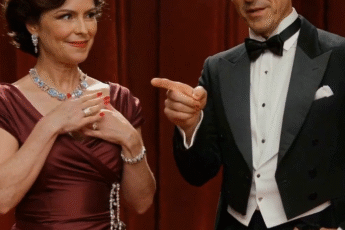
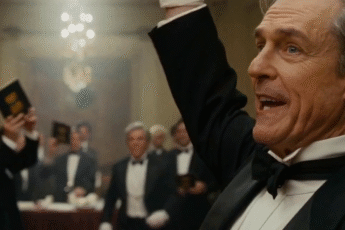
Golden chandeliers shone above velvet chairs. Waiters carried champagne between rows of wealthy collectors. Cameras waited near the stage, because everyone knew the final item of the night was not ordinary.
It was a gold pocket watch.
Small, old, and beautiful.
Its cover was engraved with tiny roses, and its chain was worn smooth by time. The auction catalog called it “The Harrington Timepiece,” once owned by the founder of one of the richest banking families in the country.
To the guests, it was a luxury object.
To Nathan Reed, it was something else entirely.
Nathan stood near the back of the room in a worn brown coat. His hands were rough, his shoes old, his hair silver. Nobody noticed him at first. He looked like a man who had entered the wrong building.
But Nathan was a watchmaker.
And forty years earlier, his father had built that watch by hand.
The auctioneer lifted the timepiece under the spotlight.
“Ladies and gentlemen,” he said, “this rare gold pocket watch is one of the last surviving private pieces from the Harrington estate. We begin at two million dollars.”
Paddles rose immediately.
Three million.
Five million.
Seven.
At the front of the room, a wealthy businessman named Victor Lang stood and raised his paddle with a smile. Victor collected rare objects not because he loved them, but because owning what others wanted made him feel powerful.
“Eight million,” he said.
The room went quiet.
The auctioneer smiled.
“Sold for eight million dollars.”
The gavel struck.
Applause filled the hall.
Victor walked to the stage and took the watch with the pride of a man accepting a crown.
That was when Nathan stepped forward.
“Please,” he said. “Don’t wind that watch.”
The applause stopped.
Victor turned slowly.
The auctioneer frowned.
“Sir, please return to your seat.”
Nathan did not move.
“That watch has not been wound in forty years,” he said. “There is a reason.”
Victor laughed softly.
“It belongs to me now.”
A few guests smiled.
Nathan’s eyes stayed on the watch.
“You bought the gold,” he said. “You did not buy the truth inside it.”
The room grew quiet.
Victor looked amused now.
“And what truth is that?”
Nathan pointed at the back of the watch.
“If you wind it once, the hidden message will appear.”
The smile left Victor’s face.
The auctioneer looked down at the watch, suddenly less confident.
A woman in the front row whispered, “Hidden message?”
Nathan stepped closer to the stage.
“My father made that watch for Edward Harrington,” he said. “But before Edward died, he brought it back to our shop. He asked my father to add one final mechanism.”
Victor looked at the auctioneer.
“Is this true?”
The auctioneer was pale.
“There is no mention of a hidden mechanism in the catalog.”
Nathan nodded.
“Because the family never wanted anyone to know.”
Victor’s fingers tightened around the watch.
The cameras moved closer.
He had planned to leave that room as a collector.
Now he was standing in the center of a mystery.
“What happens if I wind it?” Victor asked.
Nathan looked at him with tired eyes.
“The watch will open from the inside. A small metal plate will slide out.”
“And what is written on it?”
Nathan’s voice became quiet.
“The name of the person who stole the Harrington fortune.”
The room exploded into whispers.
The Harrington fortune was legendary. Forty years earlier, Edward Harrington had died suddenly, and most of his money vanished before his grandchildren could inherit it. Lawyers blamed bad investments. Newspapers called it a financial tragedy.
But many people believed someone inside the family had taken everything.
No one ever proved it.
Victor looked down at the watch again.
For the first time, he hesitated.
The auctioneer whispered, “Mr. Lang, perhaps we should have this examined privately.”
Nathan shook his head.
“No. That is how the truth disappeared the first time.”
Victor’s pride returned.
He held up the watch so everyone could see it.
“Fine,” he said. “Let’s see what an old watchmaker thinks he knows.”
Nathan’s face tightened.
“Careful. Wind it slowly.”
Victor inserted the tiny key and turned it once.
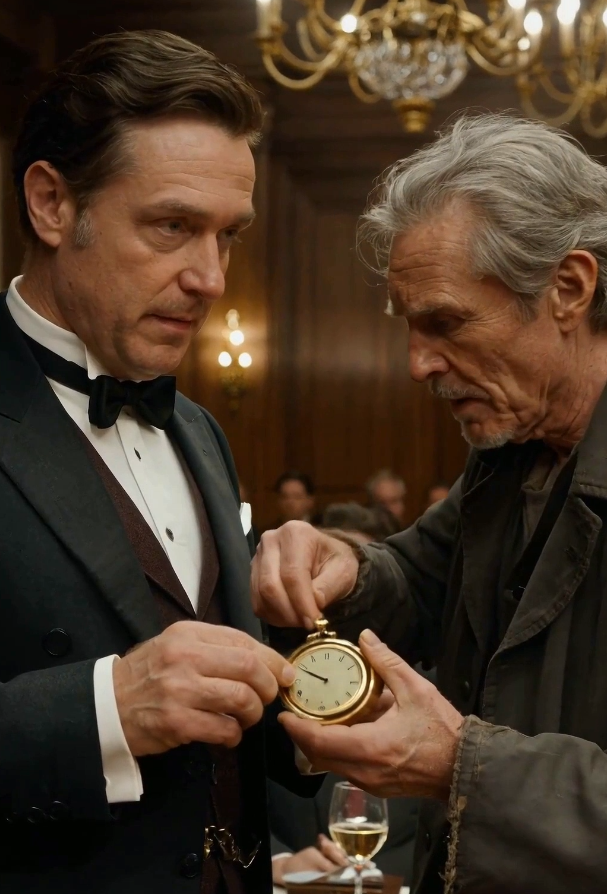
The room held its breath.
For a second, nothing happened.
Then the watch clicked.
Not loudly.
Just one clean mechanical sound.
The back cover shifted.
A small hidden plate slid out from the side, thin as a fingernail and engraved with words so tiny the auctioneer had to bring it under the stage light.
The guests stood.
Victor leaned closer.
The auctioneer read the first line.
His voice failed.
“What does it say?” someone shouted.
Nathan closed his eyes.
He already knew.
His father had told him once, when Nathan was still young.
“If that watch is ever wound again,” his father had said, “a family will finally meet the ghost it created.”
The auctioneer swallowed and began reading.
The fortune was not lost. It was moved.
The room went silent.
Victor’s hand trembled.
The auctioneer continued.
Look beneath the west bank. Account name: Marigold Trust. Authorized by—
He stopped.
The name at the bottom made him freeze.
Victor Lang’s face changed.
Because the name was not Harrington.
It was Lang.
His grandfather’s name.
The cameras flashed.
A reporter stood up.
“Mr. Lang, is your family connected to the missing Harrington fortune?”
Victor stepped back.
“This is impossible.”
Nathan looked at him.
“My father was threatened for making that mechanism. Our shop was ruined. He died with people calling him a liar.”
Victor shook his head.
“No. My family built everything honestly.”
Nathan’s voice softened.
“Maybe you believed that.”
Those words hurt more than an accusation.
The auction was stopped immediately. The watch was taken into legal custody. Reporters rushed outside to file the story. By morning, the video had spread everywhere.
A billionaire had bought an antique watch for eight million dollars, only to discover it contained the first clue to a stolen fortune linked to his own family.
Investigators reopened the Harrington case.
The Marigold Trust was real.
The west bank had merged three times, changed names twice, and hidden records behind decades of legal dust. But the account still existed. So did the transfers. So did the signatures.
Victor Lang’s grandfather had been Edward Harrington’s private financial adviser.
And he had moved millions out of the estate three days before Edward died.
The scandal destroyed the Lang family’s perfect history.
Victor tried to fight it at first. He hired lawyers. He released statements. He said the watch was fake, the mechanism planted, the old watchmaker confused.
But experts examined the timepiece.
The mechanism was original.
The engraving was forty years old.
The truth had been waiting inside gold and gears.
Nathan Reed never asked for money.
Reporters came to his tiny shop and asked how it felt to expose one of the richest families in America.
Nathan looked around at the cracked walls, the dusty counters, the old tools that had belonged to his father.
“I didn’t expose them,” he said. “My father did. I only stopped them from winding the truth in private.”
Months later, the missing money was returned to the Harrington descendants and to the workers whose pensions had been damaged by the original theft. Victor Lang stepped away from his company after admitting that his family fortune had been built on money that never belonged to them.
But one surprising thing happened.
Victor came to Nathan’s shop.
No cameras.
No lawyers.
No expensive smile.
He placed the gold pocket watch on the counter.
Nathan looked at it.
“What do you want?”
Victor’s voice was quiet.
“To know how much it would cost to repair it.”
Nathan studied him.
“The watch works.”
Victor shook his head.
“No. I mean the damage after it.”
For a long moment, Nathan said nothing.
Then he took the watch and opened the back with a small tool.
“Some things can be repaired,” he said. “But you have to stop pretending they were never broken.”
Victor nodded.
It was the first honest thing Nathan had seen him do.
Years later, the Harrington watch was placed in a public museum, not inside a private vault. Beside it was a small plaque:
The watch that kept time for forty years until someone was brave enough to listen.
Nathan visited once.
He stood in front of the glass case and looked at the tiny mechanism his father had built.
A child beside him asked his mother, “Why is that watch famous?”
The mother read the plaque and answered, “Because it told the truth.”
Nathan smiled softly.
Then he whispered, “You were right, Dad.”
And inside the glass, the old gold watch sat still, silent, and finally free of its secret.