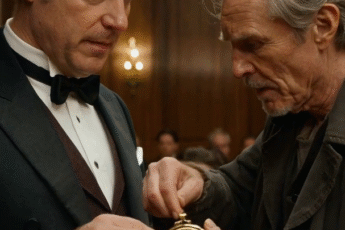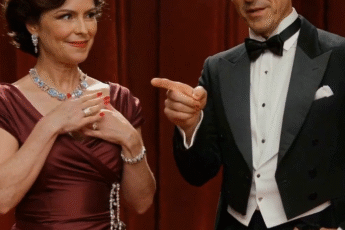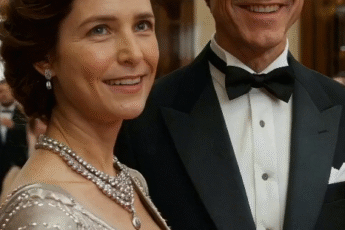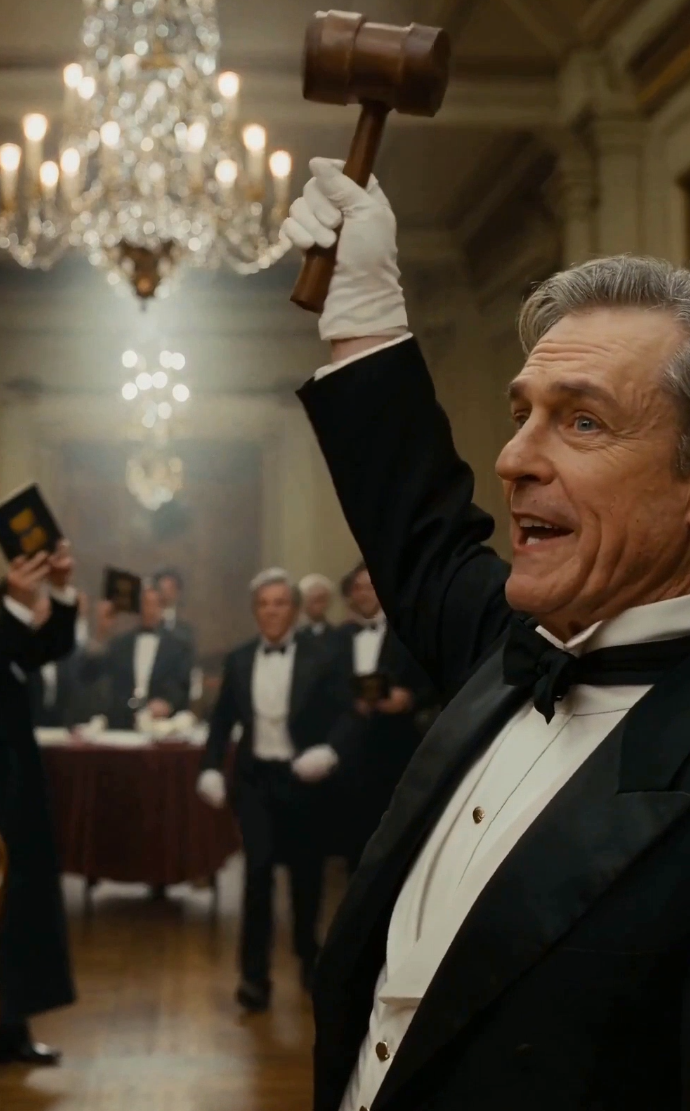
The auction hall inside the Whitfield estate looked like a room built for secrets.
Golden chandeliers reflected against polished marble floors. Antique mirrors lined the walls. Rich guests sat in velvet chairs, holding numbered paddles in their hands, whispering about paintings, jewels, rare watches, and furniture that had belonged to one of the most powerful families in the city.
At the front of the room stood Diana Whitfield.
She was the widow of Charles Whitfield, a billionaire banker who had died three months earlier. For forty years, Charles had collected art from all over the world. His mansion was full of sculptures, old books, gold-framed paintings, and objects so expensive that even touching them felt dangerous.
But that night, one painting mattered more than the rest.
It was a large portrait of a woman in a dark blue dress.
Her face was beautiful, calm, and almost sad. Her hands rested in her lap. Around her neck was a small pearl necklace. But the strangest thing about the painting was her eyes.
They seemed to follow everyone.
The auctioneer stepped forward with a smile.
“Ladies and gentlemen, we now come to the final and most valuable piece of the evening. The portrait known as The Woman in Blue.”
The room became still.
Diana stood beside the painting, smiling proudly.
She had never liked the portrait.
Charles had kept it in his private study and refused to let anyone move it. He never explained why. Whenever Diana asked, he simply said, “Some things are not meant to be understood by everyone.”
Now Charles was gone.
And Diana wanted everything sold.
The bidding started at two million dollars.
Within seconds, it reached five.
Then eight.
Then ten.
A man in the front row raised his paddle without blinking.
“Twelve million,” the auctioneer announced.
A hush passed through the room.
Diana’s smile widened.
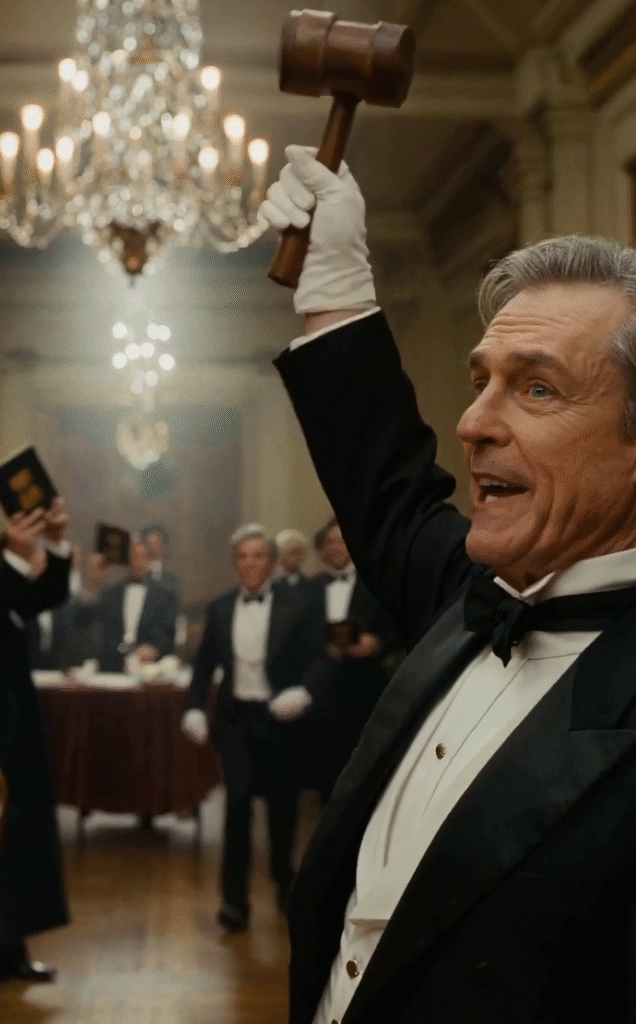
The auctioneer lifted his gavel.
“Sold for twelve million dollars.”
The gavel struck.
Applause began.
Then a voice came from the back of the room.
“Please… don’t let them take that portrait.”
The applause stopped.
Everyone turned.
Near the rear wall stood Mrs. Evelyn Moore, the housekeeper.
She was sixty-two years old, small, quiet, and dressed in a simple black uniform. She had worked in the Whitfield mansion for almost thirty years. She had polished the silver, arranged the flowers, prepared guest rooms, and cleaned rooms she was never invited to sit in.
Most of the guests had not noticed her all evening.
Now they were all staring.
Diana’s face tightened.
“Evelyn,” she said quietly, but sharply, “this is not appropriate.”
Evelyn stepped forward, her hands trembling.
“I’m sorry, Mrs. Whitfield,” she said. “But Mr. Whitfield made me promise.”
Diana’s eyes narrowed.
“Promise what?”
Evelyn looked at the portrait.
“That no one would remove it before the right person looked at her eyes.”
A few guests whispered.
The man who had bought the painting looked annoyed.
Diana gave a polite laugh for the room.
“My husband was sentimental in his final years. That painting is just part of the estate.”
Evelyn shook her head.
“No.”
The room became silent again.
Evelyn raised her hand and pointed at the woman’s eyes in the portrait.
“The safe code is painted in her eyes.”
Nobody moved.
Even the auctioneer lowered his gavel.
Diana’s smile vanished.
“What did you say?”
Evelyn swallowed.
“The safe code. Mr. Whitfield told me if anyone tried to sell the portrait, I had to stop them. He said the answer was in her eyes.”
The buyer stood.
“Is this some kind of performance?”
Diana turned cold.
“Of course not. She is confused.”
But Evelyn was not confused.
For thirty years, she had cleaned Charles Whitfield’s study every morning. She knew every corner of that room. She knew which books were never moved, which desk drawer stuck when it rained, and which wall Charles stared at when he thought no one was watching.
She also knew that Charles spoke to the portrait.
Not loudly.
Not like a madman.
But softly, at night, when the mansion was quiet.
Sometimes Evelyn heard him whisper, “I should have done it sooner.”
She never asked what he meant.
Housekeepers learn not to ask questions in rich houses.
But one month before he died, Charles called her into his study.
He was sitting beneath the portrait, weaker than she had ever seen him.
“Evelyn,” he said, “you have been the only honest person in this house for years.”
She did not know how to answer.
He handed her a small magnifying glass.
“If they sell this painting after I’m gone,” he said, “stop them.”
“Why me, sir?”
Charles looked up at the painted woman.
“Because everyone else will be too busy counting.”
Now, standing in the auction room, Evelyn remembered the weight of that magnifying glass in her palm.
She reached into her pocket and pulled it out.
The guests leaned forward.
Diana’s face went pale.
“Evelyn,” she said, “give that to me.”
But the auctioneer stepped between them.
“Mrs. Whitfield,” he said carefully, “if there is a hidden feature in the painting, we must document it before transfer.”
The buyer nodded quickly.
“For twelve million dollars, I would very much like to know what I bought.”
Evelyn walked to the portrait.
Her legs felt weak, but she kept going.
She lifted the magnifying glass to the painted eyes.
For a moment, nothing happened.
Then the auctioneer leaned closer.
His expression changed.
“There are numbers,” he whispered.
The room erupted in whispers.
Diana grabbed the edge of the stage.
“What numbers?”
The auctioneer read slowly.
“Seven. Two. Nine. Four. Eleven.”
Evelyn closed her eyes.
Charles had been telling the truth.
Diana forced a laugh, but her voice shook.
“That could mean anything.”
Evelyn turned toward her.
“He said the safe was behind the blue books.”
Diana froze.
That was when everyone knew.
There was a safe.
And Diana knew it existed.
The auction was paused.
The buyer demanded answers. The guests refused to leave. Reporters who had been covering the estate sale began recording. Within minutes, the entire room moved toward Charles Whitfield’s private study.
Diana walked in front, her face stiff with fury.
Evelyn followed behind the auctioneer.
The study smelled of old leather, dust, and expensive wood. Bookshelves covered three walls. Above the fireplace was the empty rectangle where the portrait had hung for decades.
Evelyn pointed toward the left shelf.
“The blue books.”
The auctioneer pulled one.
Nothing happened.
He pulled another.
Still nothing.
Then Evelyn noticed something.
The eleventh blue book from the left was not a book at all.
It was a wooden cover.
She pressed it.
A soft click echoed through the room.
The shelf opened.
Behind it was a small steel safe.
Diana whispered, “Charles, you fool.”
The auctioneer looked at Evelyn.
“Do you remember the numbers?”
Evelyn nodded.
Seven. Two. Nine. Four. Eleven.
The safe opened.
Inside was not jewelry.
Not cash.
Not gold.
It was a stack of red folders, tied with blue ribbon.
On top was a note written in Charles Whitfield’s handwriting.
If this has been found, then at least one honest person kept her promise.
Diana reached for the folders, but the auctioneer stopped her.
“These are now part of the estate record.”
Evelyn stared at the top folder.
There was a name written across it.
Rosewood Workers Fund.
The guests did not understand.
But Diana did.
And for the first time that night, fear entered her face.
The truth came out slowly.
Twenty-two years earlier, Charles Whitfield had closed a factory called Rosewood Textiles. Hundreds of workers lost their jobs. Their pensions vanished. Their health benefits disappeared. Newspapers called it a tragic business failure.
But it had not failed.
The folders showed that the workers’ pension money had been moved into private accounts controlled by Whitfield family companies. Charles had signed the transfers. Diana had approved them. Lawyers had buried the complaints. Families had suffered while the Whitfields grew richer.
For years, Charles had kept the evidence hidden behind the portrait.
Not because he was innocent.
Because guilt had made him afraid.
The woman in the portrait was not a famous noblewoman. She was Mary Caldwell, the first Rosewood worker who had written to Charles after the factory closed. She had sent him a photo of herself in her old blue dress and begged him to restore the pensions before people lost their homes.
Charles never answered her.
But he had a painter copy her face from the photograph and hang it in his study.
Diana had never known who the woman was.
Or maybe she had never cared.
Evelyn read the final note with shaking hands.
The money from the sale of my art collection must go first to the Rosewood families. Not to my wife. Not to my investors. Not to the people who helped me hide. If Diana fights this, the folders will explain why she should not.
Diana sat down slowly.
No one offered her comfort.
By morning, the story was everywhere.
The portrait that sold for twelve million dollars had uncovered one of the city’s oldest financial scandals. Former Rosewood workers came forward. Their children came forward. Some cried on camera. Others simply asked why it had taken so long.
The buyer returned the painting voluntarily.
He said, “Some things belong in history before they belong in a private room.”
The estate sale was frozen. Courts became involved. Diana’s lawyers fought, but the folders were too detailed, and Charles’s final instructions were too clear.
The art collection was sold.
The money went to the Rosewood families.
Not enough to repair every lost year.
Not enough to bring back parents who had died poor while their pensions sat hidden in rich accounts.
But enough to say, finally, that what happened to them had not been forgotten.
As for Evelyn, reporters called her the housekeeper who exposed a dynasty.
She did not like that.
“I only kept a promise,” she said.
Months later, the portrait of Mary Caldwell was placed in a public museum.
Not in a billionaire’s study.
Not above a private fireplace.
But in a bright room where anyone could see it.
Beside it was a small plaque:
The Woman in Blue
Portrait of Mary Caldwell, Rosewood worker.
Her eyes carried the numbers that returned a stolen future.
Evelyn visited the museum once.
She stood in front of the painting for a long time.
The painted eyes still seemed to follow her.
But now they did not feel sad.
They felt awake.
A little girl standing nearby asked her mother, “Why is everyone looking at this painting?”
Her mother read the plaque and said, “Because it told the truth.”
Evelyn smiled softly.
Then she whispered to the woman in blue, “He waited too long. But we found it.”
And for the first time, the portrait no longer looked like a secret.
It looked like justice.