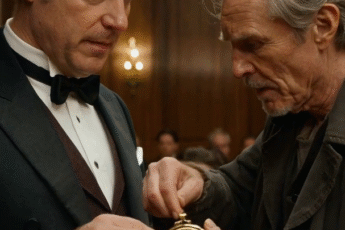
The banquet hall inside St. Augustine Medical Center looked nothing like the hospital floors below it.
There were no waiting chairs, no tired families sleeping beside vending machines, no children crying behind curtains. Upstairs, everything shined. Golden lights glowed over white tablecloths. Wealthy donors sipped champagne. Doctors laughed softly in expensive suits while photographers moved between them like bees around flowers.
At the center of the stage stood Dr. Samuel Hart.
He was the most famous heart surgeon in the state.
Magazines called him a miracle worker. Television hosts called him humble. Hospital advertisements used his face beside the words: Every life matters.
That night, he was receiving the Humanitarian Physician Award.
His wife, Elaine, stood beside him, elegant and proud. Behind them stood members of the hospital board, smiling for cameras and pretending their smiles were not rehearsed.
Dr. Hart stepped toward the microphone.
“Every patient deserves equal care in this hospital,” he said.
The room filled with applause.
Near the back table, a woman named Nora Bell did not clap.
She sat in a simple black dress that she had borrowed from her sister. Her hands were wrapped around a small blue hospital wristband. The name printed on it belonged to her eight-year-old son.
Liam Bell.
For six months, Liam had waited for surgery.
He was born with a heart condition that had slowly become worse. Nora had spent half a year calling the hospital, filling forms, waiting in offices, praying over medical bills, and telling her son to be brave when she was barely holding herself together.
Three days before the surgery, she had packed Liam’s small backpack with pajamas, socks, and his favorite dinosaur toy.
Then the hospital called.
The surgery had been delayed.
No explanation.
Just delayed.
But Nora worked in the laundry room of that same hospital. She knew how people talked when they thought the poor were too tired to listen. That morning, she had overheard two administrators whispering near the service elevator.
A donor’s son needed the same operating slot.
A family with money.
A family whose name was on the new children’s wing.
Liam had been removed from the list.
Not because his case was less serious.
Because his mother could not write a seven-figure check.
Now Dr. Hart stood on stage, accepting an award for compassion.
Nora’s fingers tightened around Liam’s wristband.
Her sister whispered, “Nora, don’t. They’ll throw you out.”
Nora looked at the doctor.
Then at the cameras.
Then at the hospital banner that said Care Without Condition.
“If not here,” she whispered, “then where?”
She stood.
At first, nobody noticed.
Then she spoke.
“Then why was my son removed from the surgery list?”
The applause faded.
Heads turned.
Dr. Hart’s smile froze.
Elaine looked from the woman to her husband.
“What is she talking about?”
Dr. Hart gave a polite laugh, the kind powerful people use when they want discomfort to disappear.
“Ma’am, patient scheduling is a private medical matter. Please speak with the office tomorrow.”
Nora stepped into the aisle.
“I spoke to the office. They said there was no room.”
A board member leaned toward security.
Nora saw the movement and raised the wristband higher.
“My son was scheduled for surgery Monday morning. His name is Liam Bell. He is eight years old. He has been waiting six months.”
The room became painfully quiet.
Dr. Hart’s eyes hardened.
“This is not appropriate.”
Nora’s voice shook, but she kept going.
“No. What happened to my son is not appropriate.”
A reporter near the stage lifted her camera.
Elaine turned fully toward her husband now.
“Samuel, answer her.”
Dr. Hart lowered the microphone slightly.
“There are medical priorities involved.”
Nora took one more step forward.
“Then tell everyone the medical reason a billionaire’s son took his place.”

The room gasped.
The board members stopped smiling.
One of them whispered, “Turn off the cameras.”
But it was too late.
The cameras were already recording.
Dr. Hart looked at Nora with a warning in his eyes.
“You should be careful with accusations.”
Nora looked at him.
“I have been careful for six months. Careful with bills. Careful with hope. Careful with telling my son not to be scared.”
Her voice broke.
“But nobody was careful with him.”
Elaine stepped away from her husband.
“Samuel,” she said quietly, “is this true?”
He did not answer fast enough.
That silence told her more than words.
Nora pulled a folded hospital schedule from her purse. It was not stolen. It had been accidentally placed inside a laundry bag with operating room linens, then thrown toward staff like everything else they did not value.
On it, Liam Bell’s name had been crossed out.
Beside it was another name.
Preston Waverly.
Everyone in the room knew that name.
The Waverly family had donated twenty million dollars to the hospital the year before.
Nora lifted the paper.
“This is my son’s place on the surgery list,” she said. “And this is the name written over it.”
The reporter stepped closer.
“Dr. Hart, did the hospital replace a child on the surgery list for a donor’s family?”
Dr. Hart looked at the board.
The board looked away.
Nora understood then.
He had not acted alone.
The whole room had been built on polished lies.
Elaine took the award from her husband’s hand and placed it on the table beside him.
The sound was small, but everyone heard it.
“How many times?” she asked.
Dr. Hart’s face changed.
Nora froze.
That was not the question she expected.
Elaine looked at the board members.
“How many times have you done this?”
No one answered.
The silence spread through the room like smoke.
A nurse standing near the back began to cry.
Then an older doctor slowly stood.
“At least four,” he said.
The board chairman snapped, “Sit down.”
But the doctor remained standing.
“Four cases I know of,” he said. “Maybe more.”
The banquet hall exploded into whispers.
Nora felt dizzy.
Her son was not the only one.
Dr. Hart looked furious now.
“You have no idea what pressure this hospital is under.”
Nora stared at him.
“My son is under pressure too. His heart is failing.”
The words ended every excuse.
The next morning, the video was everywhere.
Millions watched Dr. Hart accept an award for equal care while a poor mother exposed the secret surgery list. Reporters camped outside St. Augustine. Families began calling the hospital, asking if their loved ones had been pushed aside too.
By noon, the state health department announced an investigation.
By evening, Dr. Hart stepped down from his leadership role.
The hospital board called it a misunderstanding.
No one believed them.
But Nora did not care about public statements. She did not care about hashtags, interviews, or strangers calling her brave online.
She cared about Liam.
Two days later, Liam’s surgery was restored.
Not because the hospital suddenly became kind.
Because the world was watching.
On Monday morning, Nora walked beside her son’s hospital bed as nurses rolled him toward the operating room. Liam held his dinosaur toy against his chest.
“Mom,” he whispered, “are they mad at us?”
Nora bent down and kissed his forehead.
“No, baby.”
“Then why are there cameras outside?”
She smiled through tears.
“Because you matter, and now everyone knows it.”
The surgery lasted six hours.
Nora spent every minute in the waiting room, holding the blue wristband that had started everything. She prayed. She paced. She remembered every time someone had made her feel small for asking questions.
When the surgeon finally came out, it was not Dr. Hart.
It was a quiet woman named Dr. Patel, who had been one of the first doctors to speak to investigators.
She removed her mask.
“Liam did well,” she said. “His heart is strong.”
Nora collapsed into the chair and cried into both hands.
Weeks passed.
Liam recovered slowly. He learned to walk down the hallway again. He complained about hospital food. He asked when he could go back to school.
That was when Nora finally breathed.
The investigation uncovered more than one secret list.
Wealthy donors had been given silent priority for years. Hospital administrators had hidden delays behind vague scheduling language. Poor families were told to wait, to be patient, to trust the system.
But the system had not been built to hear them.
So Nora made sure they were heard.
With help from nurses, doctors, and families who came forward, she started a patient advocacy group called The Waiting Room Project.
Their first rule was simple:
No family should have to be rich to be seen.
Elaine Hart joined quietly after separating from Samuel. She donated money, but Nora made one thing clear.
“We do not need charity that buys silence,” Nora told her. “We need support that protects truth.”
Elaine nodded.
“Then tell me where to stand.”
A year later, St. Augustine Medical Center removed the donor-priority system completely. A public oversight board was created. Surgical lists became transparent to patient advocates. Several executives resigned.
Dr. Hart never received another humanitarian award.
But inside a small apartment across town, Liam Bell framed something more important than any trophy.
His old blue hospital wristband.
Under it, Nora wrote:
The day they remembered my name.
Every time Liam looked at it, he smiled.
Not because he understood every part of what had happened.
But because he knew his mother had stood up in a room full of powerful people and made them listen.
Years later, when Liam was asked what saved his life, doctors expected him to say surgery.
Instead, he said, “My mom’s voice.”
And Nora, standing behind him, finally understood something.
Sometimes the smallest object in the room is not small at all.
A wristband.
A name.
A place on a list.
A mother refusing to sit down.
That was all it took to turn a hospital’s hidden shame into a truth no one could ignore.