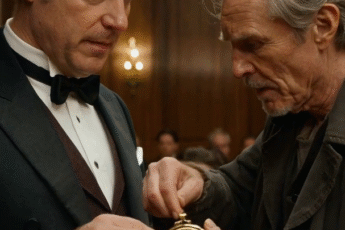
When Ethan Montgomery told his parents he was bringing someone to dinner, his mother expected a woman from their world.
Someone with a famous last name.
Someone who knew which fork to use without looking.
Someone whose family owned buildings, charities, or at least a vineyard in Napa.
That was the kind of woman Margaret Montgomery had always imagined for her only son.
The Montgomery mansion sat behind iron gates at the top of a private hill, with marble steps, tall windows, and gardens trimmed so perfectly they looked almost unreal. Inside, the dining room glittered under a crystal chandelier. The long table was set with gold-rimmed plates, silver cutlery, and white roses arranged in tall glass vases.
Margaret sat at the head of the table in a cream silk dress, her posture perfect, her expression calm.
Her husband, Robert, sat beside her, quieter than usual.
He had learned over thirty years of marriage that when Margaret was waiting to judge someone, even the air in the room became careful.
At exactly eight o’clock, Ethan entered.
He was handsome, confident, and usually relaxed in every room he walked into. But that night, his shoulders were tense.
Beside him stood a young woman in a simple navy dress.
She was beautiful, but not in the polished way Margaret expected. Her hair was softly tied back. Her hands were nervous. She wore no diamonds, no designer label, no expensive confidence.
Still, she stood with quiet dignity.
Ethan gently held her hand.
“Mom, Dad,” he said, his voice sincere, “this is Emma. I love her.”
The room became still.
Margaret’s eyes moved over Emma slowly. Her dress. Her shoes. Her face. The way she stood too carefully, as if she already knew she did not belong there.
Then Margaret smiled.
It was not a warm smile.
“I didn’t expect this,” she said. “Who exactly are you?”
Emma opened her mouth, but Ethan answered first.
“She makes me happy. That should be enough.”
Robert looked down at his glass.
Margaret noticed.
So did Emma.
For a few seconds, nobody spoke.
Then Margaret’s eyes narrowed slightly. She studied Emma’s face again, this time not with judgment, but with recognition. Something in her expression changed. The coldness remained, but underneath it appeared something sharper.
Fear.
Margaret slowly stood from her chair.
“Then ask her,” she said, “where we met five years ago.”
Ethan turned to Emma.
The blood had drained from her face.
“Emma?” he asked softly.
Emma looked at Margaret, then at Robert, then back at Ethan.
“I wanted to tell you,” she whispered.
Margaret let out a short laugh.
“Of course you did.”
Ethan released Emma’s hand without meaning to.
“What is she talking about?”
Emma’s eyes filled with tears, but she stayed standing.
“Five years ago, I worked at one of your family’s hotels,” she said. “The Montgomery Grand.”
Ethan frowned.
“My parents own dozens of hotels. Why would that matter?”
Emma looked at Margaret.
“Because your mother came there one night with a woman named Clara Reed.”
Margaret’s face hardened.
Robert finally looked up.
“Margaret,” he said quietly.
But she ignored him.
Emma continued, her voice shaking.
“I was working as a server at a private event. I was nineteen. I didn’t know who anyone was. I just knew I needed that job.”
Ethan stared at her, confused.
“What happened?”
Emma looked down.
“A necklace disappeared that night. A diamond necklace. Your mother said someone from the staff had taken it.”
Margaret folded her arms.
“And it was found in your locker.”
Emma looked up quickly.
“It was placed in my locker.”
The room went silent.
Ethan turned to his mother.
“Is that true?”
Margaret’s face did not move.
“The necklace was found where it was found.”
Emma’s voice broke.
“I lost my job that night. I lost my scholarship the next week because the hotel filed a report. My mother had just started chemotherapy. We needed my income. I begged them to check the cameras, but no one listened.”
Ethan took one step back.
He looked at his father.
“Dad?”
Robert’s face was pale now.
Margaret snapped, “Do not drag your father into this.”
But Robert closed his eyes.
And in that moment, Ethan understood something terrible.
His father knew.
Emma wiped a tear from her cheek.
“I spent five years rebuilding my life from that night. I worked double shifts, paid my mother’s bills, and finished college online. When I met Ethan, I didn’t know who he was at first. By the time I found out, I was already in love with him.”
Margaret laughed coldly.
“How convenient.”
Ethan’s voice sharpened.
“Mom, stop.”
Margaret looked at him, stunned.
He had never spoken to her that way before.
Ethan turned back to Emma.
“Why didn’t you tell me?”
“Because every time I tried, I heard your last name,” Emma whispered. “And I remembered the security guards walking me out while everyone stared at me like I was dirt.”
Her words hit him harder than he expected.
Margaret stepped closer.
“This is exactly why I was worried. She came into your life with a story prepared.”
“No,” Robert said suddenly.
Everyone turned.
Margaret’s face changed.
“Robert.”
But he stood slowly, as if the truth had become too heavy to keep sitting with.
“She did not steal the necklace,” he said.
Ethan stared at him.
“What?”
Robert’s voice was low.
“I saw the footage.”
Margaret’s hands tightened around the back of her chair.
Ethan looked between them.
“You saw the footage and did nothing?”
Robert swallowed.
“The necklace was placed in Emma’s locker by Clara Reed’s assistant.”
Emma froze.
Clara Reed was Margaret’s closest friend. A wealthy widow, a powerful donor, and the woman who had stood beside Margaret at every charity event for years.
Margaret’s voice turned icy.
“Robert, be careful.”
But Robert had already crossed the line.
“Clara wanted the insurance money,” he said. “The necklace was real, but she reported it for twice its value. She needed someone poor enough to blame and powerless enough to disappear.”
Emma’s hand covered her mouth.
Ethan looked at his mother.
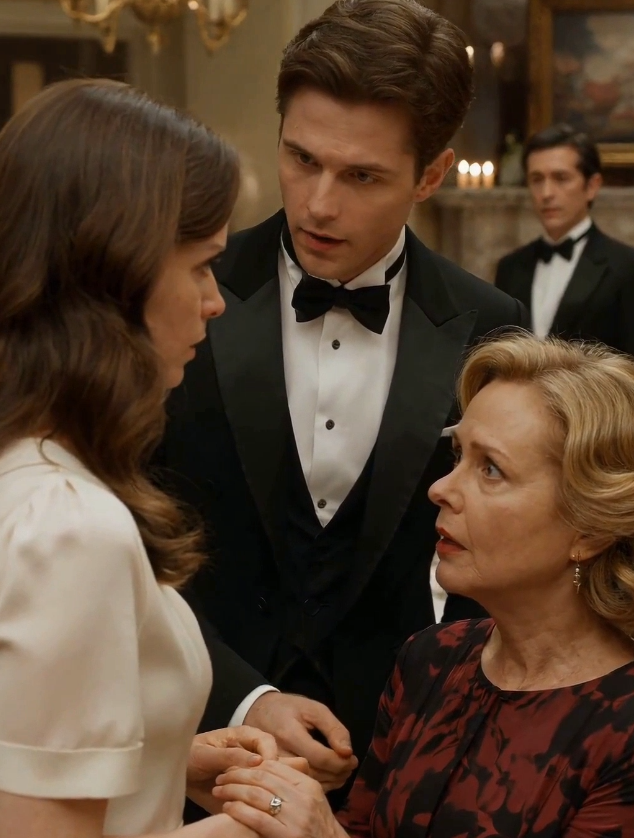
“And you knew?”
Margaret looked away.
That was enough.
Ethan’s voice dropped.
“You knew she was innocent.”
Margaret finally snapped.
“I protected this family.”
“No,” Ethan said. “You protected a lie.”
Margaret’s eyes filled with anger, but Robert’s face filled with shame.
“I should have spoken,” Robert said to Emma. “I told myself it was too late, that reopening it would hurt too many people. But the truth is, I was a coward.”
Emma’s tears fell silently.
For five years, she had wondered if anyone in that room had known. If anyone had watched her life fall apart and chosen comfort over justice.
Now she had her answer.
Ethan turned to Emma.
“I’m sorry,” he whispered.
But Emma shook her head.
“You didn’t do it.”
“No,” he said. “But I brought you here without knowing what this house had already done to you.”
Margaret spoke sharply.
“Ethan, do not be dramatic. This girl is using your guilt.”
Ethan looked at his mother as if he was seeing her clearly for the first time.
“She has a name.”
Margaret went quiet.
“Her name is Emma.”
For a moment, no one moved.
Then Emma stepped back from the table.
“I shouldn’t have come,” she said.
Ethan reached for her hand, but she gently pulled away.
“I love you,” she whispered. “But I cannot stand in a room where people discuss my pain like it is an inconvenience.”
She turned and walked toward the door.
Ethan followed her immediately.
Margaret called after him.
“If you leave now, do not expect this family to welcome her back.”
Ethan stopped.
He turned slowly.
“Then maybe Emma was never the one who didn’t belong here.”
And he left.
The next morning, Ethan did something his family never expected.
He found the old hotel records.
He hired a lawyer.
He contacted the school that had withdrawn Emma’s scholarship.
Then he sent Robert’s statement, the security footage, and Clara Reed’s insurance documents to the proper authorities.
Within a week, the story became public.
Clara Reed was investigated for fraud. Margaret Montgomery resigned from two charity boards. Robert gave a formal apology and admitted he had failed an innocent young woman because silence had been easier than courage.
But Emma did not celebrate.
The truth did not give her back the five years she had lost.
It did not erase the nights her mother cried because the bills were unpaid. It did not erase the humiliation of being escorted out of a hotel kitchen while coworkers whispered behind her back.
Still, it gave her something important.
Her name.
Clean.
Untouched by their lie.
Months passed before Emma agreed to see Ethan again.
They met in a quiet park, far from marble floors and chandeliers.
Ethan looked different. Less polished. More human.
“I don’t expect you to forgive my family,” he said.
“I don’t,” Emma replied.
He nodded.
“But I needed to tell you something,” she continued. “I was angry at you because loving you made me feel like I had walked back into the place that broke me.”
Ethan’s eyes softened.
“I understand.”
Emma looked at him for a long moment.
“But you walked out with me.”
He smiled sadly.
“I should have known sooner.”
“You know now,” she said.
A year later, Emma opened a small legal support fund for service workers falsely accused by powerful employers. Ethan helped quietly, without putting his name on the website or appearing in photos.
Robert donated too, but Emma returned his first check.
When he asked why, she said, “Apologies should come before money.”
So he came in person.
He stood in her office, older and smaller than she remembered, and said the words he should have said five years earlier.
“I saw the truth and stayed silent. I am sorry.”
Emma accepted the apology.
Not because it fixed everything.
Because she refused to carry his shame for him anymore.
As for Margaret, she never truly apologized.
People like her rarely do.
But one evening, months later, Ethan received a message from his mother.
It said only:
I was wrong about her.
Ethan showed it to Emma.
Emma read it, then handed the phone back.
“That’s not enough,” she said.
“No,” Ethan answered. “But it’s a beginning.”
Emma looked out the window of her little office, where two young hotel workers were waiting for help with their own case.
Then she smiled softly.
“Good,” she said. “Let her learn slowly. I had to.”
And for the first time, the Montgomery name no longer felt like a shadow over her life.
It felt like evidence.
Evidence that rich rooms can hide ugly truths.
Evidence that silence can destroy innocent people.
And evidence that one woman, standing at a dinner table where she was never meant to feel welcome, could finally make the truth sit down and answer.