The ballroom at the Grand Meridian Hotel was filled with applause before the billionaire even opened his mouth.
Golden chandeliers glittered above the crowd. Cameras flashed near the stage. Waiters moved between tables with silver trays, and every guest wore the kind of expensive smile people use when they know they are being photographed.
At the center of the stage stood Alexander Voss.
He was one of the most famous businessmen in the city. His face appeared on magazine covers, charity posters, and television interviews. People called him generous. They called him visionary. They called him the man who never forgot the poor.
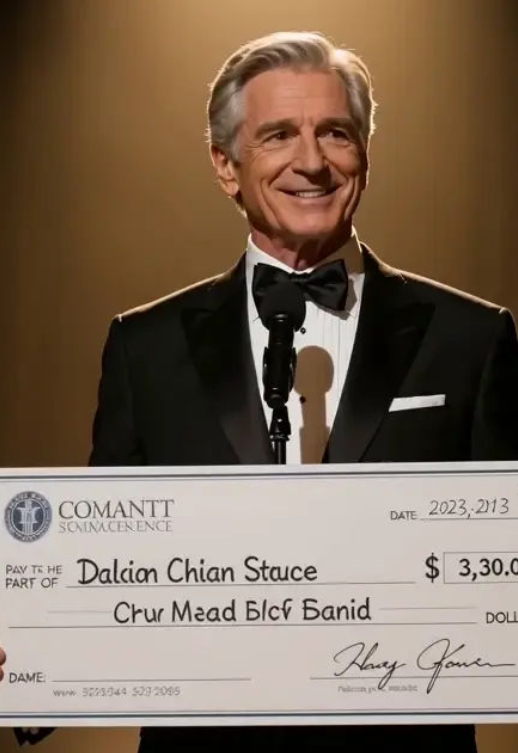
That night, he stood beside a giant check made out for ten million dollars.
The money was supposed to go to Little Harbor Kitchen, a small charity that fed hungry children after school.
Alexander’s wife, Evelyn, stood beside him in a silver dress, smiling softly for the cameras. She had helped organize the gala and believed the donation would change hundreds of lives.
The crowd quieted as Alexander stepped toward the microphone.
“Tonight,” he said, lifting his chin proudly, “I donate ten million dollars to hungry children.”
The ballroom exploded with applause.
People stood. Cameras flashed. Guests wiped fake tears from their eyes. Alexander smiled wider, turning slightly so every photographer could capture his best angle.
But near the back of the room, one young woman did not clap.
Her name was Lena Carter.
She wore a simple black dress, the cheapest one she owned. She worked at Little Harbor Kitchen, washing dishes, packing meals, and helping children with homework when they waited for their parents after school.
That morning, she had watched the kitchen close.
Not because the children stopped coming.
Because the rent was unpaid.
Because suppliers had stopped delivering food.
Because the donation Alexander Voss had promised weeks earlier had never arrived.
Lena had spent the whole day calling banks, offices, assistants, and charity managers. Everyone told her the same thing.
“The transfer is coming.”
But it never came.
And now Alexander was standing on stage, smiling like a hero, while the children he claimed to save had been sent home hungry.
Lena’s hands shook around her phone.
Her friend beside her whispered, “Don’t do this here.”
Lena looked at the stage.
At the giant check.
At the cameras.
At Alexander’s perfect smile.
“If not here,” she whispered, “then where?”
She stood up.
At first, nobody noticed her.
Then her voice cut through the applause.
“Then why did the children’s kitchen close this morning?”
The clapping died slowly.
Alexander’s smile froze.
Every face turned toward Lena.
Evelyn looked confused.
“What is she talking about?” she asked her husband.
Alexander gave a small laugh into the microphone.
“Ladies and gentlemen, charity work can be emotional. I’m sure this young woman is mistaken.”
Lena stepped into the aisle.
“I’m not mistaken.”
Security moved toward her, but several cameras had already turned in her direction.
Alexander’s voice stayed calm, but his eyes hardened.
“Please don’t interrupt a serious event.”
Lena raised her phone.
“This morning, thirty-eight children came to Little Harbor Kitchen for breakfast. We had to tell them there was no food. We had to lock the doors.”
A murmur moved through the room.
Evelyn slowly turned to Alexander.
“You said the money was sent last week.”
Alexander leaned away from the microphone and whispered, “Evelyn, not now.”
But the cameras caught that too.
Lena walked closer to the stage.
“You promised ten million dollars,” she said. “But the bank account received nothing.”
Alexander’s smile vanished for half a second, then returned.
“That is completely false.”
Lena unlocked her phone with trembling fingers and held it toward the cameras.
“Then explain this.”
On the screen was the charity’s official bank record.
No transfer.
No pending deposit.
No donation.
Just a balance so small it could not even pay one month of rent.
The room went silent.
A journalist in the front row stood up.
“Mr. Voss, can you confirm the donation was sent?”
Alexander did not answer.
Another reporter asked, “Is the check ceremonial, or has the money actually been transferred?”
Evelyn’s face turned pale.
“Alexander?”
He lowered the microphone.
For the first time all night, he looked less like a hero and more like a man trapped in his own spotlight.
“It was scheduled,” he said quietly.
Lena shook her head.
“No. It was advertised. It was photographed. It was printed on invitations. But it was never sent.”
The words landed harder than shouting.
Evelyn stepped away from him.
“You used those children for publicity?”
Alexander turned to her, angry now.
“Don’t be dramatic.”
But the damage was already done.
The guests were whispering. Reporters were recording. Donors were checking their phones. The giant check behind him no longer looked generous.
It looked like a prop.
Lena looked at the crowd.
“There are children who came to that kitchen every day because it was the only warm meal they had. They don’t care about chandeliers. They don’t care about your cameras. They don’t care about his speech.”
Her voice broke, but she kept going.
“They just wanted breakfast.”
No one clapped this time.
No one smiled.
Evelyn took the microphone from Alexander’s hand.
He tried to stop her, but she pulled away.
“Lena,” Evelyn said, her voice shaking, “how much does the kitchen need to reopen tomorrow?”
Alexander whispered, “Evelyn, don’t.”
She ignored him.
Lena looked stunned.
“To reopen tomorrow?” she asked. “At least fifty thousand. To stay open for the year, maybe six hundred thousand.”
Evelyn turned to the crowd.
“I will personally send one million dollars tonight.”
The ballroom gasped.
Then she looked directly at her husband.
“And tomorrow morning, my lawyers will find out where the ten million dollars went.”
Alexander’s face hardened.
“You are embarrassing me.”
Evelyn’s eyes filled with tears, but her voice became stronger.
“No, Alexander. You embarrassed yourself. She just turned on the lights.”
The next morning, the video was everywhere.
Millions watched Alexander Voss announce a fake donation and then stand frozen as a young charity worker exposed him. Sponsors withdrew. Reporters camped outside his office. Other charities began reviewing every promise he had ever made.
By noon, the truth came out.
The ten million dollars had never been set aside for Little Harbor Kitchen. Alexander had planned to use the announcement to improve his public image before a major business deal. His team expected the attention to fade before anyone asked whether the money had arrived.
But Lena had asked.
And because she asked in front of the cameras, the lie had nowhere to hide.
Little Harbor Kitchen reopened two days later.
Not with Alexander’s money.
With donations from thousands of ordinary people who saw the video and sent what they could. Ten dollars. Twenty dollars. Five dollars from a retired teacher who wrote, “No child should be turned away from breakfast.”
Evelyn kept her promise too.
She sent the million dollars, then separated from Alexander within the month.
But Lena never became comfortable with fame.
Reporters called her brave. Strangers recognized her at the grocery store. People asked how it felt to bring down a billionaire.
She always gave the same answer.
“I didn’t bring anyone down. I asked why children were hungry after a man promised to feed them.”
Months later, Little Harbor Kitchen looked different.
The walls were painted bright yellow. The pantry shelves were full. A new sign hung above the entrance:
Promises don’t feed children. People do.
Every afternoon, kids filled the room with noise, laughter, and homework questions. Lena still washed dishes. She still packed meals. She still tied little shoes and reminded children to take fruit before they left.
One evening, a boy named Marcus looked up from his soup and asked, “Are you the lady from the video?”
Lena smiled.
“I guess so.”
“Did you yell at the rich man?”
“I asked him a question.”
Marcus thought about that seriously.
“Was he scared?”
Lena looked toward the kitchen window, where the sunset was turning the glass gold.
“Yes,” she said softly. “But not of me.”
“Then what?”
Lena placed a bowl in front of him.
“The truth.”
Marcus nodded like that made perfect sense, then went back to eating.
And Lena finally understood something.
The most powerful moment in that ballroom had not been the applause, the cameras, the giant check, or even the billionaire’s frozen face.
It had been the silence after the lie was exposed.
Because in that silence, everyone had to choose what kind of person they wanted to be.
Some looked away.
Some made excuses.
But enough people chose to help.
And because of that, the next morning, the doors of Little Harbor Kitchen opened again.