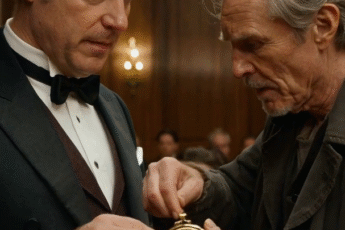
The courtroom was already full when the boy walked in.
No one noticed him at first.
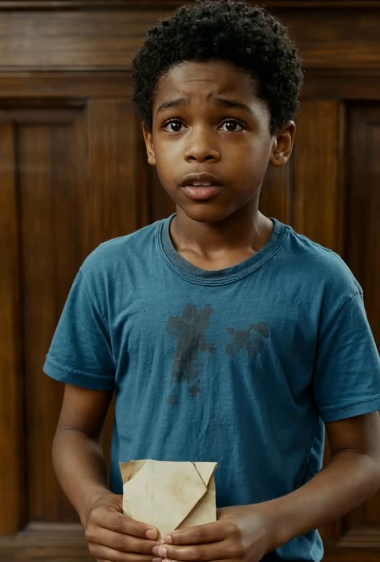
He was small, maybe ten years old, with shoes too old for his feet and a jacket that looked like it had survived more winters than he had. His hair was messy, his face pale, and in both hands he held a yellow envelope so tightly that its corners had begun to bend.
At the front of the room, Judge Edward Marlow sat high above everyone, calm and untouchable.
People feared him.
Lawyers lowered their voices when they spoke to him. Police officers stood straighter in his courtroom. Reporters waited outside for one sentence from him, because one sentence from Judge Marlow could destroy a man’s life or save it.
That morning, he was about to sentence a young woman accused of stealing medicine from a private hospital.
The woman stood beside her lawyer, trembling.
“My daughter was sick,” she whispered. “I had no money.”
The prosecutor shook his head.
“The law is the law, Your Honor.”
Judge Marlow leaned forward, his expression cold.
“In this courtroom,” he said, “we do not excuse crimes with sad stories.”
The room became silent.
That was when the boy stepped forward.
At first, a guard tried to stop him.
“Kid, you can’t be here.”
But the boy looked past the guard, straight at the judge.
“Your Honor,” he said, his voice shaking, “my mother said to give you this before she died.”
The courtroom froze.
Judge Marlow’s eyes moved from the boy’s face to the envelope in his hands.
For one tiny second, something changed in him.
It was not anger.
It was fear.
“Who was your mother?” the judge asked.
The boy swallowed hard.
“Her name was Clara.”
The judge’s fingers tightened around the edge of his desk.
No one else noticed, but the woman waiting to be sentenced did. So did one reporter in the back row, who slowly lowered his pen.
“Clara who?” the judge asked.
The boy took another step forward.
“Clara Bell.”
A sound moved through the courtroom — not a gasp, not a whisper, but something in between.
The judge stood up.
“Remove him,” he ordered.
But the boy shouted before the guard could touch him.
“She said you would pretend not to know her!”
The words hit the room like thunder.
Everyone turned toward the judge.
His face had gone pale.
The boy lifted the envelope.
“She said if I ever got scared, I should find you. She said you owed her the truth.”
The judge stared at the envelope as if it were a weapon.
“Give it to me,” he said.
The boy shook his head.
“No. She said to open it in front of everyone.”
The guard looked at the judge, waiting for an order. The lawyers looked at each other. The reporters were no longer writing. They were watching.
Slowly, the boy tore open the envelope.
Inside was an old photograph.
He held it up.
It showed a much younger Edward Marlow, before the gray hair, before the black robe, before the power. Beside him stood a beautiful young woman, smiling with tired eyes. In her arms was a newborn baby wrapped in a blue blanket.
On the back of the photo, written in faded ink, were six words:
Tell him his father is alive.
The courtroom erupted.
The judge slammed his hand on the desk.
“Silence!”
But his voice cracked.
The boy looked up at him with tears in his eyes.
“My mother said you left before I was born. She said you chose your career over us. But she also said… you were not always a bad man.”
The judge could not speak.
For the first time in his life, Edward Marlow looked small.
The accused woman standing near the defense table began crying quietly. Maybe because she saw herself in the boy’s mother. Maybe because she knew what it meant to be judged by people who had never been hungry, desperate, or alone.
The boy walked closer.
“I didn’t come for money,” he said. “I didn’t come to ruin you.”
“Then why did you come?” the judge whispered.
The boy looked down at the photograph.
“Because my mother died believing you would do the right thing at least once.”
The room went completely silent.
Judge Marlow slowly sat down.
His eyes moved to the woman he had been ready to sentence only minutes earlier.
A mother who had stolen medicine for her child.
A poor woman with no power.
A woman he had nearly punished because the law was easier to believe in than mercy.
The judge removed his glasses.
For a long moment, he said nothing.
Then he looked at the prosecutor.
“Drop the charges.”
The prosecutor blinked.
“Your Honor?”
“I said drop the charges.”
The woman covered her mouth and collapsed into tears.
But the judge was not looking at her anymore.
He was looking at the boy.
“What is your name?” he asked.
The boy hesitated.
“Daniel.”
Judge Marlow closed his eyes.
That was the name Clara had wanted.
Years ago, before he ran, before he lied, before he became a man who punished others for the same desperation he had created.
He stepped down from the bench.
Everyone watched in disbelief as the most feared judge in the city walked across the courtroom and stopped in front of a poor child with an old envelope.
“I don’t deserve forgiveness,” he said.
Daniel looked at him.
“No,” the boy answered. “But my mother said I should give you a chance to earn it.”
The judge’s lips trembled.
Then Daniel reached into the envelope again.
“There’s one more thing.”
The judge froze.
Daniel pulled out a second paper — a hospital document, folded carefully.
The reporter in the back lifted his camera.
The judge whispered:
“What is that?”
Daniel opened it with shaking hands.
And when the judge saw the name written on the document, all the color disappeared from his face.
Because Clara had not died from sickness.
She had died after signing a confession.
A confession that said Judge Marlow had not only abandoned his son…
He had sent an innocent man to prison to hide the truth.
And that innocent man was Daniel’s real father.