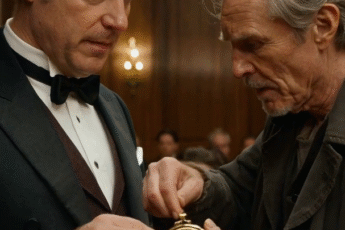
The restaurant was full of people who paid more for one dinner than Sofia Ramirez used to spend on groceries for a week.
Crystal glasses shined under warm golden lights. White tablecloths covered every table. Waiters moved silently between rich guests, and cameras waited near the open kitchen to capture the most important moment of the night.
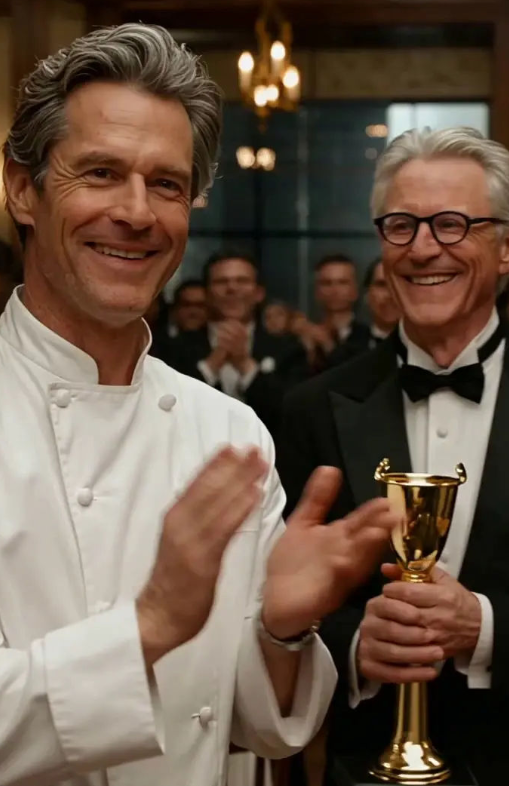
Chef Adrian Vale was about to receive the Golden Plate Award.
To the world, Adrian was a genius. He had a television show, a bestselling cookbook, and three restaurants with waiting lists longer than most wedding guest lists. He smiled like a man who had already won at life.
Beside him stood Nathan Brooks, the most feared food critic in the country. One good review from Nathan could make a restaurant famous. One bad review could destroy it.
In Nathan’s hands was a small golden trophy.
“Tonight,” Nathan said to the room, “we honor the genius behind this masterpiece.”
The guests applauded.
Adrian placed one hand over his heart and gave a humble smile.
Near the open kitchen, Sofia stood in a plain black kitchen uniform, holding a tray of empty plates.
No one clapped for her.
No one knew she had been awake since five that morning. No one knew she had chopped vegetables, washed pans, cleaned floors, and quietly fixed mistakes made by chefs who looked through her like she was part of the equipment.
No one knew the award-winning dish had been hers.
It was called The Midnight Pear.
A delicate dessert made with roasted pears, dark honey, warm spices, and a thin crisp of almond sugar. The critics called it elegant. Emotional. Unforgettable.
Sofia called it her grandmother’s recipe.
Her grandmother, Rosa, had made it in a tiny kitchen every winter when money was short and the house was cold. She used to say, “A good dessert does not need gold. It needs memory.”
When Sofia started working at Adrian’s restaurant, she brought the recipe only once.
It was after closing, during staff meal, when everyone was tired and hungry. She made it from leftover pears so they would not be thrown away. The kitchen went quiet when people tasted it.
Even Adrian tasted it.
He said nothing at first.
Then he asked, “Where did you learn this?”
“My grandmother,” Sofia told him.
The next week, the dessert appeared on the restaurant menu.
But not under Sofia’s name.
Under his.
When Sofia confronted him privately, Adrian smiled.
“You should be grateful,” he said. “Your little family recipe is on a real menu now.”
“It’s mine,” she whispered.
He leaned closer.
“You wash dishes here, Sofia. Don’t confuse kindness with importance.”
From then on, she watched strangers praise him for something that belonged to her family. She watched him describe the dessert in interviews, inventing a story about his childhood in France, even though every spice in the recipe came from Rosa’s old kitchen in Arizona.
Sofia wanted to quit.
But rent was due.
Her younger brother needed school supplies.
Her mother’s medicine was expensive.
So she stayed.
And stayed.
Until the night of the award.
Nathan Brooks lifted the trophy higher.
“Chef Vale,” he said, “your Midnight Pear may become one of the defining dishes of modern American dining.”
The guests clapped again.
Sofia’s hands tightened around the tray.
Adrian stepped toward the microphone.
“I created this dish from a memory,” he said. “A memory of hunger, warmth, and home.”
Something inside Sofia broke.
Not because he stole the recipe.
Because he stole the memory too.
She set the tray down and stepped forward.
“Then why did he steal the recipe from me?”
The applause stopped.
Adrian’s smile froze.
Every guest turned.
Nathan lowered the trophy slightly.
Adrian laughed, soft and cruel.
“Excuse me?”
Sofia’s voice trembled, but she did not move back.
“That dessert is my grandmother’s recipe.”
A few guests whispered.
Adrian smiled wider, as if he were embarrassed for her.
“This is an emotional kitchen assistant,” he said. “Long nights can be difficult.”
Sofia looked at him.
“You didn’t create The Midnight Pear.”
Adrian’s eyes hardened.
“You’re a dishwasher,” he said. “Nobody will believe you.”
The room went completely silent.
Even Nathan Brooks stopped moving.
Sofia felt the insult land in front of everyone. For one second, she was twelve years old again, standing behind her grandmother at a grocery store while someone spoke slowly to Rosa because of her accent.
Then she remembered Rosa’s voice.
Do not shrink because someone wants more room.
Sofia raised her hand and pointed toward the open kitchen.
“Then why is my grandmother’s handwriting in your notebook?”
Adrian’s face changed.
A young sous-chef near the counter looked down.
Everyone followed Sofia’s finger.
On the stainless-steel prep table beside Adrian’s leather notebook were several old recipe pages. The paper was yellowed, folded, and covered in blue ink. The writing was careful but uneven.
At the top of one page were the words:
Rosa’s Winter Pears
Nathan walked toward the kitchen.
Adrian moved quickly to stop him.
“Nathan, this is ridiculous.”
But Nathan ignored him.
He picked up one of the pages and read it.
Then he opened Adrian’s notebook.
His expression changed.
The same steps.
The same measurements.
The same phrase written in the margin:
Add honey last, so the fruit remembers the sun.
Nathan looked up slowly.
“Chef Vale,” he said, “why is this exact sentence in your notebook?”
Adrian opened his mouth.
No answer came.
Sofia’s eyes filled with tears.
“My grandmother wrote that,” she said. “She said it every time she made the dish.”
The guests began whispering louder now.
A woman at the front table stood up.
“I filmed him saying this was his own childhood recipe.”
Another guest said, “He said it on television last week.”
Nathan closed the notebook.
The golden trophy remained in his other hand.
For a long second, he looked at Adrian, then at Sofia.
“This award,” Nathan said, “was meant for the creator of the dish.”
Adrian’s voice became sharp.
“You can’t do this here.”
Nathan looked around the room.
“Where would you prefer truth to happen? In private, where it can be buried?”
Adrian’s face turned red.
Sofia stood still, barely breathing.
Nathan walked back to the front of the room. Then, in front of the cameras, the guests, and every member of the kitchen staff, he placed the Golden Plate Award on the counter in front of Sofia.
“This belongs to the person whose memory we tasted tonight.”
For a moment, nobody clapped.
The room was too shocked.
Then someone in the kitchen started.
One clap.
Then another.
Then the dishwashers clapped. The line cooks clapped. The waiters clapped. Finally, the guests joined in.
Sofia cried quietly, one hand over her mouth.
Adrian walked out before the applause ended.
By morning, the scandal was everywhere.
Videos from the dinner spread across social media. Old interviews resurfaced. Former employees began telling similar stories. Adrian Vale had built an empire on “inspiration” taken from people who were too tired, too poor, or too afraid to fight back.
His television show paused production.
His cookbook publisher announced an investigation.
His restaurants stayed open, but the name above the door no longer felt untouchable.
Sofia did not become rich overnight.
Truth rarely works that fast.
But Nathan Brooks wrote a column the next day titled The Dish Belonged to Sofia Ramirez.
He told the whole story: Rosa’s winter pears, the stolen notebook, the insult in the dining room, and the moment an award changed hands.
People came to the restaurant, not for Adrian, but for Sofia’s dessert.
For the first time, the menu printed the name correctly:
Rosa’s Midnight Pear — by Sofia Ramirez
Three months later, Sofia left Adrian’s restaurant.
Not angrily.
Not secretly.
She left through the front door.
Nathan helped her meet investors, but Sofia refused to open anything fancy. Instead, she rented a tiny corner space on a quiet street and painted the walls the same warm yellow as her grandmother’s kitchen.
She called it Rosa’s Table.
There were only eight tables.
The chairs did not match.
The plates were simple.
But every night, people lined up outside.
Sofia cooked the way Rosa had taught her: slowly, honestly, with no shame in humble ingredients. She hired cooks nobody else took seriously. Dishwashers. Single mothers. Immigrants with recipes in their heads and no certificates on paper.
Above the kitchen door, Sofia hung a small sign:
No one steals what we remember.
On opening night, Sofia placed one bowl of Midnight Pear on a small table by the window.
Her younger brother asked, “Who is that for?”
Sofia smiled through tears.
“For Grandma.”
The dessert cooled slowly in the golden light.
And for the first time, Sofia did not feel like someone had taken her memory.
She felt like she had brought it home.