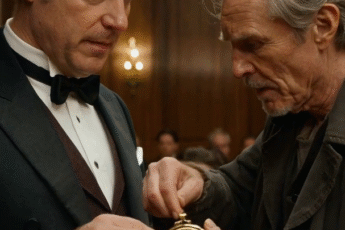
Ethan Cole had not tasted his mother’s apple pie in thirty years.
Not because he hated it.
Because remembering it hurt too much.
He was now one of the richest businessmen in Chicago. He owned restaurants, hotels, office towers, and a private apartment high above the city. People called him powerful. Magazines called him self-made.
But Ethan knew the truth.
He had not built his life from nothing.
He had built it by running away from everything.
His mother, Mary Cole, had raised him in a tiny kitchen behind an old bakery. She worked from sunrise until midnight, flour always on her hands, a smile always on her tired face. Every Sunday, no matter how little money they had, she baked him an apple pie.
“Cinnamon first,” she used to say. “Then a little lemon peel. That’s how you make sadness taste sweet.”
When Ethan became successful, he left that neighborhood behind.
At first, he promised to visit.
Then he promised to call.
Then years passed.
By the time he returned, the bakery was closed, the apartment was empty, and a neighbor told him his mother had died.
Ethan never asked many questions.
Maybe because he was afraid of the answers.
One rainy evening, Ethan sat alone in the most expensive restaurant he owned. Around him, people whispered his name. Waiters moved carefully. Everyone wanted his approval.
Then the front door opened.
An elderly woman stepped inside.
She looked completely out of place.
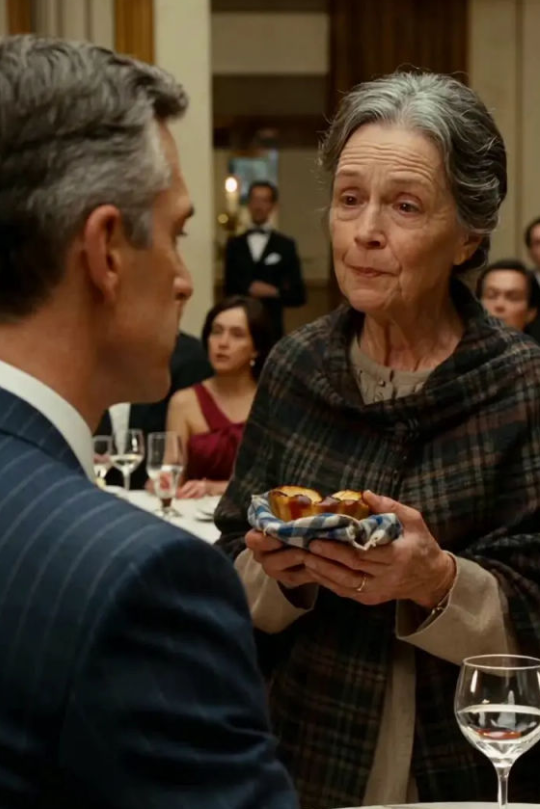
Her coat was old. Her shoes were wet from the rain. Her hands trembled around a small package wrapped in cloth.
The host tried to stop her.
“Ma’am, you can’t come in here.”
But the woman looked past him and saw Ethan.
“I only need one minute,” she said.
Ethan looked up, irritated.
The entire restaurant watched as the woman walked slowly toward his table.
She stopped beside him and placed the cloth package in front of him.
“Please,” she whispered. “Just taste this pie.”
Ethan stared at her.
“I don’t eat food from strangers.”
The woman’s face tightened, but she did not leave.
She carefully opened the cloth.
Inside was a small apple pie.
It was not perfect. The crust was uneven. The edges were too dark. A little cinnamon had spilled over the side.
But the smell reached Ethan before he could look away.
Cinnamon.
Butter.
Lemon peel.
His chest tightened.
The woman said softly, “Your mother made it this way every Sunday.”
Ethan froze.
The noise of the restaurant faded.
He slowly looked up.
“How do you know my mother?”
The woman’s eyes filled with tears.
“Because I was with her the day she stopped waiting for you.”
The words hit him like a closed door.
Ethan stood.
“Who are you?”
“My name is Ruth,” she said. “I worked at the bakery with Mary.”
Ethan’s face hardened.
“My mother died thirty years ago.”
Ruth shook her head.
“No, Ethan. She died twelve years ago.”
He stared at her.
“That’s impossible.”
“She lived in that same little apartment for eighteen years after you left,” Ruth said. “Every Sunday, she baked your pie and set a plate at the table.”
Ethan’s lips parted, but no words came.
Ruth reached into her coat and pulled out an old envelope.
“She wrote you letters. Hundreds of them. But she never mailed most of them. She said a busy son should not be made to feel guilty.”
Ethan took the envelope with shaking hands.
Inside was a letter written in handwriting he had not seen since childhood.
My dear Ethan,
I saw your picture in the newspaper today. You looked tired, but handsome. I am proud of you. I hope someone is making sure you eat. I baked your pie again today. I know you are busy, but I saved you a slice, just in case.
Ethan’s eyes burned.
He turned to Ruth.
“Why are you bringing this to me now?”
Ruth looked down at the pie.
“Because tomorrow they are tearing down the old bakery. Your mother asked me, before she passed, to give you one last pie if I ever found the courage.”
Ethan sat slowly.
For the first time in years, the powerful man looked like a lost boy.
The restaurant was silent now.
Ethan picked up the fork.
His hand trembled as he cut a small piece of the pie.
The taste broke him.
Not loudly.
Not dramatically.
Just one tear, then another.
He saw the old kitchen. His mother laughing with flour on her cheek. The tiny table. The rain against the window. The warmth he had spent thirty years pretending he did not need.
“She waited for me?” he whispered.
Ruth nodded.
“Every Sunday.”
Ethan covered his face.
“I thought she was gone.”
“No,” Ruth said gently. “You were.”
That sentence stayed with him longer than the pie.
The next morning, Ethan stopped the demolition of the old bakery. He bought the entire building back and restored it exactly as it had been. Same blue door. Same wooden counter. Same little kitchen in the back.
But he did not turn it into a luxury restaurant.
He opened it as a free bakery for lonely elderly people, single parents, students, and anyone who needed a warm meal.
Above the door, he placed a sign:
Mary’s Sunday Pie
Every Sunday, Ethan came himself.
He wore an apron instead of a suit.
He learned the recipe from Ruth.
Cinnamon first.
Then lemon peel.
At first, he burned the crust. Then he used too much sugar. Then one Sunday, Ruth tasted it and smiled.
“That’s it,” she said. “That’s Mary’s pie.”
Ethan looked away, wiping his eyes.
Years later, people still knew him as a rich man.
But in the old neighborhood, they knew him differently.
They knew him as the man who served pie every Sunday at the table where his mother had waited.
And every week, before the bakery opened, Ethan placed one slice on a small plate near the window.
Not because he believed his mother would come back.
But because love, once ignored, still deserved a place at the table.