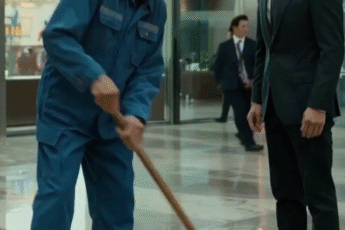
Every morning at 6:00 a.m., an old man named Thomas Gray entered the marble lobby of Hartwell Industries with a mop, a bucket, and a quiet smile.
No one noticed him.
That was the point.
The employees passed him without looking. Some stepped around his wet floor sign like he was part of the furniture. Others dropped coffee cups beside trash cans and expected him to pick them up.
Thomas never complained.
He only watched.
Hartwell Industries was one of the fastest-growing tech companies in America. Its headquarters had glass walls, private elevators, indoor gardens, and conference rooms named after famous inventors.
But behind the expensive image, something was wrong.
The company’s founder had passed away two years earlier, and his son, Daniel Hartwell, had taken over as CEO. Daniel looked perfect in interviews. He spoke about kindness, innovation, and family values.
Inside the building, he was different.
He fired people with a smile. He mocked older employees. He treated receptionists, cleaners, assistants, and cafeteria workers like they were invisible.
And the young executives copied him.
One Monday morning, Thomas was cleaning near the main conference room when Daniel walked in with five executives behind him.
A young man named Carter stepped too close to the wet floor and almost slipped.
Thomas reached out to steady him.
“Careful, sir,” Thomas said gently.
Carter pulled his arm away as if Thomas had dirtied his suit.
“Careful, old man,” he said loudly. “This floor costs more than your life.”
The executives laughed.
Thomas lowered his eyes.
Daniel Hartwell heard the comment.
He looked at Thomas, then at Carter.
For a moment, Thomas thought the CEO might say something.
Instead, Daniel smiled.
“Ignore him,” Daniel said. “He’s just the cleaner.”
The words echoed softly in the hallway.
Thomas said nothing.
He simply picked up his bucket and moved aside as the executives entered the conference room.
Inside, they were preparing for the most important meeting of the year. Rumors had been spreading for weeks that Hartwell Industries was about to be bought by a private investor. Nobody knew the buyer’s name.
Daniel was nervous, but he tried not to show it.
“If this deal closes,” he told his team, “we’ll be untouchable.”
Carter laughed.
“Then we can finally replace half the staff.”
Daniel smirked.
“Starting with the useless ones.”
Outside the glass wall, Thomas heard every word.
He kept cleaning.
At exactly 9:00 a.m., the elevator doors opened.
A woman in a black suit walked into the lobby with three serious-looking board members behind her. Her name was Eleanor Price, the chairwoman of Hartwell’s board.
Daniel immediately stood up inside the conference room.
“Eleanor,” he said warmly. “We’ve been waiting.”
But Eleanor was not looking at Daniel.
She was staring at the janitor.
Her face went pale.
Then she walked past the CEO, past the executives, and stopped directly in front of Thomas.
The room became silent.
“Sir…” Eleanor whispered. “Why are you dressed like that?”
Daniel frowned.
Carter looked confused.
Thomas slowly removed his rubber cleaning gloves.
“Because,” he said calmly, “I wanted to see how this company treats people when it thinks they are nobody.”
No one breathed.
Daniel’s smile disappeared.
Eleanor turned toward the room.
“Gentlemen,” she said, “this is Mr. Thomas Gray.”
Carter gave a nervous laugh.
“The janitor?”
Eleanor’s eyes hardened.
“No. The man who bought your company.”
The silence was heavier than shouting.
Daniel’s face drained of color.
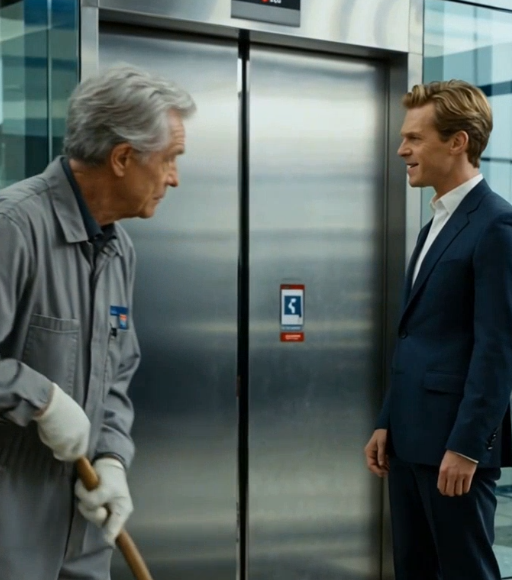
Thomas walked into the conference room. His steps were slow, but every person moved aside for him.
He placed the cleaning gloves on the table.
“I spent three weeks in this building,” Thomas said. “I listened. I watched. I wanted to know whether Hartwell Industries still had the heart its founder built it with.”
Daniel swallowed.
“Mr. Gray, I can explain.”
Thomas looked at him.
“Can you?”
Daniel tried to smile.
“I didn’t know who you were.”
“That,” Thomas said softly, “is exactly the problem.”
Carter stared at the floor.
The other executives avoided Thomas’s eyes.
Thomas reached into his uniform pocket and pulled out a small notebook. It was filled with names.
Daniel glanced at it.
“What is that?”
“The names of people in this building who were kind when they had nothing to gain,” Thomas said.
He opened the notebook.
“The receptionist who brought me tea when she thought my hands were cold. The cafeteria worker who packed extra food for an intern. The security guard who helped an elderly visitor find the right floor. The assistant you shouted at last Thursday, who still stayed late to fix your mistake.”
Then Thomas closed the notebook.
“And the names of people who treated others like objects.”
Carter’s face turned red.
Daniel’s voice became quiet.
“Are you firing us?”
Thomas looked around the room.
“No,” he said. “Not today.”
Relief moved across Daniel’s face.
Then Thomas added, “Today, I’m giving every person in this room one chance to become better before power is taken from them.”
Eleanor placed a folder on the table.
Daniel opened it with trembling hands.
Inside was a new company restructuring plan.
The executive bonus program was frozen. Employee wages were increased. Every department would be reviewed anonymously by the staff. Managers with repeated complaints would be removed.
And Daniel Hartwell would no longer make decisions alone.
“You can’t do this,” Daniel whispered.
Thomas looked at him sadly.
“I already did.”
For the first time in his life, Daniel Hartwell had nothing to say.
Over the next three months, the company changed.
Not quickly.
Not perfectly.
But truly.
The receptionist became head of employee experience. The cafeteria worker received funding to open a wellness kitchen inside the building. The assistant Daniel had shouted at was promoted after Thomas discovered she had been quietly doing the work of three managers.
Carter resigned after being asked to apologize to every service worker he had humiliated.
Daniel stayed.
But not as the same man.
Thomas made him spend one full month working anonymously in every department: mailroom, cafeteria, customer support, maintenance, reception.
At first, Daniel hated it.
Then he began to understand.
He saw how hard people worked when no one praised them. He saw how often leaders took credit for invisible labor. He saw how easily power could make a person blind.
One evening, Daniel found Thomas in the lobby, standing near the same spot where Carter had insulted him.
Daniel walked over slowly.
“I thought success meant being above people,” Daniel said.
Thomas looked at him.
“And now?”
Daniel looked around the building.
“Now I think it means being trusted by them.”
Thomas smiled.
That was the first time Daniel saw approval in the old man’s eyes.
A year later, Hartwell Industries became one of the most respected companies in the country—not because of its technology, but because of how it treated its people.
Reporters often asked Thomas Gray why he had pretended to be a janitor.
He always gave the same answer.
“You learn more from how people treat the cleaner than from how they treat the buyer.”
And inside the main lobby, beside the marble wall, Thomas placed a small bronze sign.
It said:
No one here is nobody.