The crystal chandeliers sparkled beneath the ceiling of the grand hall, casting golden reflections over the polished marble floor, silk dresses, and impeccable suits. That night, wealth needed no introduction—it was evident in every detail. Against the far wall rested a sleek, black grand piano—silent yet commanding. Beside it stood a slender fifteen-year-old waiter, his uniform perfectly pressed. His shoes showed signs of wear but were clean. He gripped a silver tray firmly, but his eyes kept drifting back to the piano, as if it were calling to him.
To the guests, he was invisible—just another staff member to move quietly and disappear when not needed. But inside him stirred something stronger than the background music. Summoning all the courage he had gathered throughout the evening, he approached a tall man in a navy blue suit, whose watch must have cost a fortune. “Could I… play this piano?” he asked softly. The man smiled mockingly, loud enough for others to hear. “You? Have you ever played the piano in your life?” Some guests chuckled gently, convinced it was impossible. The boy’s cheeks flushed, but instead of retreating, he set down the tray and sat before the piano.
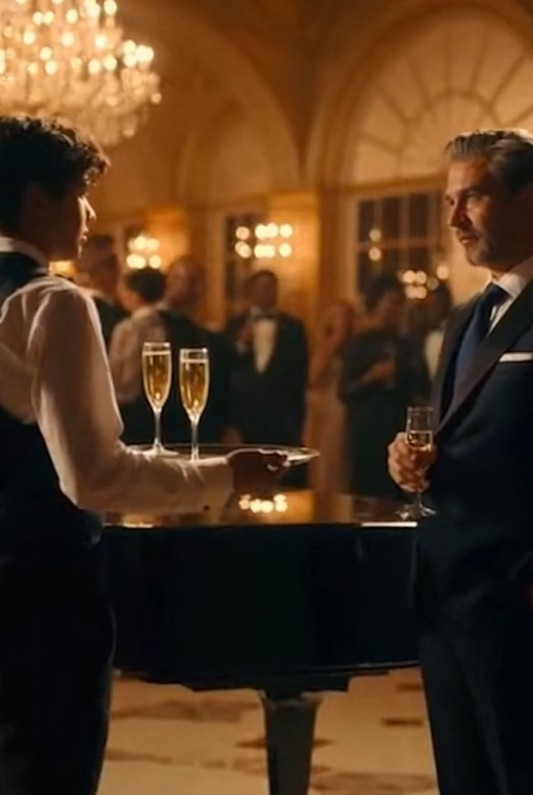
A curious murmur swept through the room. His hands hovered over the keys, and as his sleeve slid back slightly, a small guitar-shaped tattoo appeared on his wrist. The man’s expression changed instantly. Years ago, in certain musical circles, a video had circulated of a young boy playing with overwhelming intensity on a broken keyboard in the street, a guitar symbol drawn beside him. Then the boy vanished without a name. Recognition pressed on his chest. “Wait… is that you?” he whispered.
The boy answered not with words, but with music. The first note rang clear and pure; then another, and another, until the melody filled the hall and silenced every conversation. It was more than talent—it was memory, longing, hope, and pain woven together. Guests slowly turned, glasses frozen mid-air. When the last note faded, a deep silence fell before the applause erupted. “What’s your name?” the man asked gently. “Daniel,” he replied. He shared how his mother taught him to play before illness weakened her, and how he played in the subway because the music alone wasn’t enough to pay for her medicine.
Months later, that very same melody echoed in a much larger concert hall. Daniel was no longer standing on the sidelines with a tray; he was center stage, before an audience gathered just to hear him. The man who once mocked him watched from the crowd, grateful he had been wrong. Because sometimes the simplest question—“May I play?”—becomes the turning point in a life the world nearly ignored, and the one nobody saw turns out to be the one everyone was waiting for.