They thought it was just another traffic stop.
A beat-up silver sedan. A young Black woman driving fast through the rain.
But when the officer pulled her out of the car, something slipped from her purse onto the wet pavement —
and the moment they read the words on it, the world seemed to stop.
Rain drizzled over the narrow streets of Atlanta, Georgia.
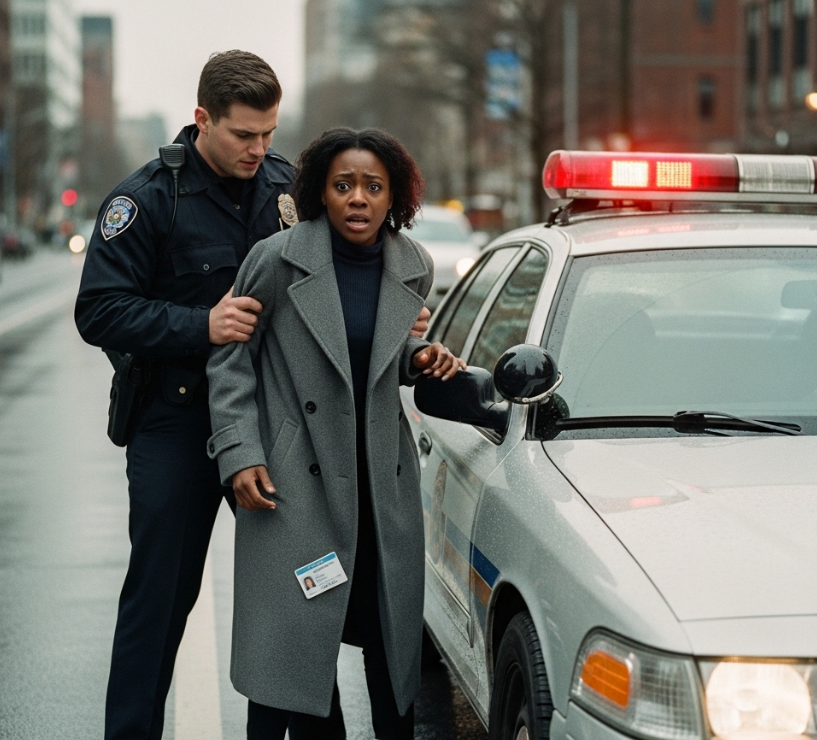
Red and blue lights flashed across the wet asphalt, reflecting on a silver sedan pulled over by the curb.
“Hands where I can see them!” — the officer’s voice cut through the rain.
Aisha Brown, a 26-year-old Black woman in a gray coat, froze.
Her hands trembled on the steering wheel.
“I… I’m on my way to the hospital,” she stammered.
The officer yanked the door open, pulling her out.
Her purse dropped. Papers scattered across the road.
A small plastic card slid out of her wallet, landing face-up in a puddle —
under the flashing light, one line stood out in bold:
“DOCTOR — Emory Medical Center.”
Both officers froze.
The younger one bent down, picked up the card, and stared at the photo.
It was her.
The same woman they had just dragged out of the car.
“You’re… a doctor?” the senior officer murmured.
Aisha nodded slowly, her voice trembling.
“I’m a resident physician. I just finished an 18-hour shift… I was speeding because one of my patients crashed. I had to get back.”
Rain filled the silence that followed.
The sound of guilt was heavier than the storm itself.
The younger officer — Jake Miller — took a step back.
He looked at the card again, then at her.
“God… I thought you were—”
He stopped. His throat tightened.
“Your car… it’s old, the plates are worn out, no hospital sticker… I just—”
“You just assumed,” she said softly.
Aisha wasn’t angry.
Her face was calm, her voice low, but her eyes — tired, human, sincere — said everything.
The senior officer, Lieutenant Hayes, cleared his throat.
“Doctor Brown… we’re sorry. We didn’t know.”
She looked at him for a long moment, then whispered:
“You don’t need to apologize to me.
Just remember — every time you see someone with skin like mine… think for a second.
Maybe they’re also trying to save a life.”
Her words hung in the air like rain that refused to fall.
Aisha gathered her things, took the ID, and got back into her car.
The engine started.
Her taillights disappeared into the mist.
The two officers stood there — silent, wet, changed.
Three days later, Jake was sent to Emory Hospital to file a report on a car accident.
When he walked into the ER, he froze.
Dr. Aisha Brown was there — white coat, stethoscope, exhaustion still etched under her eyes.
“Officer Miller,” she greeted quietly, as if nothing had happened.
“Room three. The patient’s waiting.”
He nodded, unable to speak.
As he turned to leave, she said softly:
“Officer Miller.”
He stopped.
“I hope that night made you see things differently.”
Jake exhaled, voice low:
“It didn’t just change how I see… it changed who I am.”
Weeks later, the Atlanta Police Department released a new training video.
It showed a reenactment of that night — the flashing lights, the rain, the mistake.
At the end, a single line appeared on screen:
“Every person deserves to be seen — before being judged.”
Jake Miller wrote that line.
During the press briefing, when they mentioned the woman who inspired it,
everyone knew exactly who she was — Dr. Aisha Brown.
One late evening, Aisha finished a long shift and stepped out of the hospital.
A police car idled by the entrance.
Jake stepped out, holding a small bouquet of white daisies.
“I didn’t know what flowers doctors like,” he said awkwardly.
“So I picked daisies. They felt… honest.”
Aisha smiled — the kind of smile that softens even the hardest memories.
Rain began to fall again, light and gentle.
Streetlights shimmered on the pavement between them.
“You know,” she said quietly, “I believe everyone can change.
They just need someone willing to stop — and listen.”
Jake nodded.
“You stopped. And I’m still listening.”
The scene faded under the glow of soft yellow streetlights —
two people standing quietly, no longer divided by fear, but connected by understanding.
Sometimes, a single act of prejudice can destroy trust.
But sometimes, a moment of compassion can rebuild it.
All it takes is the courage to look —
and truly see the person in front of you.