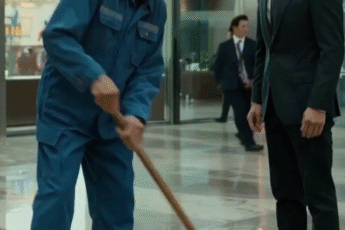
In the glass heart of a modern corporate skyscraper in downtown Manhattan, mornings always looked the same—sharp suits, fast coffee, louder ambition.
And somewhere between all of it, an old janitor moved quietly through the marble lobby.
His name, as far as most employees were concerned, didn’t matter. To them, he was just “the cleaner”—someone who appeared before they arrived and disappeared after they left. A man in a faded blue uniform, pushing a cart that squeaked softly against the polished floor.
No one ever asked who he was.
That morning, the building was especially tense. A major board meeting was scheduled on the top floor, and rumors were flying about a potential buyout. People were nervous, and nervous people often became cruel to those who couldn’t answer back.
Three young employees stood near the elevator, laughing loudly, coffee cups in hand.
One of them glanced at the janitor mopping near their shoes.
“Careful,” he said with a smirk. “That floor costs more than your entire life.”
The others laughed.
The janitor didn’t stop cleaning. He only said calmly, almost softly:
“I know.”
That made them laugh even harder.
Another employee leaned in, amused. “Then what are you doing here? You lost your job upstairs or something?”
The janitor finally looked up. His expression wasn’t angry. Just tired in a way none of them understood.
“I wasn’t lost,” he said. “I chose to be here today.”
A brief silence passed—but only briefly.
The laughter returned.
Then the receptionist suddenly appeared from the side entrance, slightly out of breath, her expression tense.
“Mr. Keller is on his way up,” she said quickly.
The mood shifted instantly.
Everyone straightened. Even the joking stopped.
One of the employees whispered, “The CEO is coming?”
But the janitor didn’t react.
He simply squeezed the mop dry and continued as if nothing had changed.
When the elevator doors opened, the atmosphere froze.
A tall man in a tailored suit stepped out—security behind him, executives following. He scanned the room once, then his eyes locked onto the janitor.
And immediately, everything changed.
The CEO stopped walking.
So did everyone else behind him.

The arrogant employee who had been laughing earlier suddenly felt his throat go dry.
The CEO spoke quietly, but clearly:
“You’re late for your own meeting.”
The lobby went silent.
The janitor finally stood upright, resting his hand on the mop handle like it was no longer needed.
“I wanted to see how they treat people when they think no one is watching,” he said.
The CEO nodded once, respectfully.
The employees were confused.
One of them finally forced out a question:
“…Wait. Who is he?”
The CEO didn’t answer immediately.
Instead, he looked at the janitor and said:
“Ladies and gentlemen… meet the founder of this company.”
The silence that followed wasn’t just shock—it was collapse.
The floor beneath their confidence seemed to disappear.
The janitor—no, the founder—turned slowly toward the employees who had mocked him.
No anger. No revenge.
Just understanding.
“I built this place,” he said quietly. “Not so people could feel small… but so they never forget what small feels like.”
The arrogant employee took a step back, unable to meet his eyes.
“I’m sorry,” he whispered.
The janitor studied him for a moment.
Then he shook his head gently.
“You didn’t insult me,” he said. “You revealed yourself.”
A pause.
Then, unexpectedly, he added:
“But people can change… if they learn early enough.”
He turned toward the CEO.
“Cancel the board meeting.”
The CEO nodded without question.
Gasps spread through the lobby.
The janitor continued:
“Today, I’m not looking at numbers. I’m looking at character.”
He began walking toward the elevator. But halfway there, he stopped.
Without turning around, he said one last thing:
“The floor you walk on… always remembers how you treated the person who cleaned it.”
Then he stepped into the private elevator.
The doors closed.
And for the first time that morning, no one in the building knew who they were supposed to be anymore.