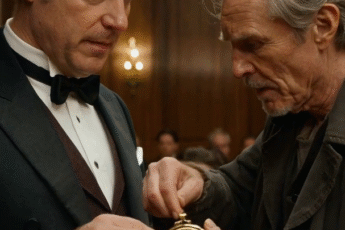
The private hospital room on the ninth floor did not look like a hospital room.
It looked like a hotel suite.
There were fresh white roses on the table, a leather sofa by the window, a private bathroom with marble tiles, and a wall of glass overlooking the city lights. Machines beeped softly beside the bed, but everything else had been arranged to hide the truth.
Harold Whitman was dying.
He was one of the richest men in the city. For forty years, he had owned hotels, luxury apartments, shopping centers, and restaurants that ordinary people could never afford to enter. His name was on buildings, charity halls, and university plaques.
But now he was just an old man in a hospital bed, weak, pale, and barely able to speak.
Around him stood his three adult children.
Evan, the oldest son, wore a navy suit and kept checking his watch. Caroline, his daughter, stood with her arms crossed, pretending to cry whenever a doctor entered. And Miles, the youngest, sat near the window scrolling on his phone.
None of them had visited Harold much before that week.
But the moment they heard his health was failing, they all arrived.
Not with flowers.
With lawyers.
On the table beside the bed was a thick folder of papers.
Evan leaned over his father.
“Dad,” he said quietly, though everyone could hear the impatience in his voice, “just sign the papers. We’re your real family.”
Harold’s eyes were closed.
He did not answer.
Caroline sighed.
“The doctors said he understands us. He’s just being stubborn.”
Miles looked up from his phone.
“If he signs tonight, we can avoid a long legal mess.”
At the foot of the bed stood a young nurse named Emma.
She was twenty-four, with tired eyes and a calm voice. She had been assigned to Harold’s room for the past two weeks. She checked his medication, adjusted his blanket, brought him water, and spoke to him even when his children ignored him.
To them, she was invisible.
Just the nurse.
Evan turned to her sharply.
“Can you give us some privacy?”
Emma looked at Harold.
His weak hand moved slightly on the blanket.
She had seen that movement before.
It meant no.
“I’m sorry,” Emma said. “The patient asked me to stay.”
Caroline laughed coldly.
“The patient is our father.”
Emma kept her voice gentle.
“And he is still my patient.”
Evan stepped closer to the bed.
“Dad, listen to me. You built everything for us. We’re your blood. We’re the ones who carry your name.”
Harold’s breathing changed.
Emma noticed his eyes moving beneath his lids.
Evan picked up a pen and placed it in his father’s hand.
“Just sign,” he whispered. “We’re your real family.”
That was when Emma finally spoke.
“Then why did he list me as his daughter?”
The room froze.
Evan slowly turned.
“What did you say?”
Emma held the hospital tablet against her chest. Her hands were trembling, but she did not lower her eyes.
“The emergency family contact form,” she said. “He updated it yesterday.”
Caroline looked at her like she had insulted the entire family.
“You’re just his nurse.”
Emma swallowed.
“I thought so too.”
Miles stood up now.
“What kind of game is this?”
Emma looked at Harold, then at the tablet.
“Yesterday, when he was stronger, Mr. Whitman asked me my mother’s name. I told him. Then he asked when I was born. I told him that too. After that, he cried for almost an hour.”
Caroline rolled her eyes.
“This is ridiculous.”
But Evan had gone pale.
“What was your mother’s name?” he asked.
Emma looked at him.
“Laura Bennett.”
Harold’s eyes opened.
The room went silent.
The old man turned his head with great effort and reached one shaking hand toward Emma.
She stepped closer.
He took her hand.

His voice was weak, but clear enough for every person in the room to hear.
“No,” he whispered. “She’s not just my nurse.”
Caroline’s face changed.
Harold looked at Emma with tears in his eyes.
“She’s the only child I never abandoned.”
For the first time that night, nobody spoke.
The machines kept beeping.
The city lights kept glowing outside the window.
But inside room 904, the Whitman family had cracked open.
Emma stared at the old man.
“What are you saying?”
Harold squeezed her hand.
“Your mother worked at my first hotel,” he whispered. “Before I was rich. Before I became… this.”
His voice broke.
“I loved her. I promised her everything. Then my father found out. He said she would ruin the family name. He sent her away. I let him.”
Emma’s eyes filled with tears.
“My mother told me my father died before I was born.”
Harold closed his eyes.
“She was kinder than I deserved.”
Evan looked furious now.
“So what? You made a mistake twenty-four years ago. That doesn’t make this nurse part of our family.”
Harold turned his head toward him.
“You came here for papers.”
Evan opened his mouth, but Harold continued.
“She came here every night with water. With medicine. With kindness. She sat beside me when none of you answered my calls.”
Caroline’s face hardened.
“This is manipulation. She found out who you were and planned this.”
Emma stepped back as if she had been slapped.
“I didn’t know,” she whispered. “I swear I didn’t know.”
Harold’s eyes sharpened with the last strength he had.
“She didn’t come looking for me,” he said. “God sent her to the room of the man too cowardly to look for her.”
That sentence ended the argument.
Even Miles looked away.
Emma wanted to pull her hand back, but Harold held it gently.
“I searched once,” he whispered. “Years later. I found out Laura had died. I was told the child was gone too.”
Emma shook her head.
“No one told me anything.”
“I know,” Harold said. “And I don’t deserve forgiveness.”
Tears slipped down Emma’s face.
“Then why say it now?”
Harold looked at the folder on the table.
“Because they asked me to sign away everything I built to people who only remembered I was their father when I was close to dying.”
Evan stepped forward.
“That’s not fair.”
Harold turned to him.
“No. What I did to Laura was not fair. What I did to Emma was not fair. This is just the truth arriving late.”
The next morning, the scandal spread through the hospital before it reached the news.
Harold Whitman had updated his will.
Not to punish his children completely.
But to tell the truth.
Each of his children would receive enough money to live comfortably, but they would no longer control the company. Half of his estate would fund a medical foundation in Laura Bennett’s name, supporting young nurses from poor families. The other half would be held in trust for Emma, not as payment, but as acknowledgment.
Emma refused it at first.
“I don’t want money for being abandoned,” she told him.
Harold, weaker than ever, smiled sadly.
“It is not for being abandoned,” he said. “It is for everything your mother should have had.”
Two days later, Harold passed away before sunrise.
Emma was the only one in the room.
She had finished checking his medication when he opened his eyes one last time.
“Did Laura hate me?” he whispered.
Emma thought about lying.
Then she remembered her mother’s old music box, the one with the hotel logo carved into the wood. Her mother had kept it all her life.
“No,” Emma said softly. “I think she waited for you to become brave.”
Harold cried.
“I was too late.”
Emma held his hand.
“Yes,” she whispered. “But you were not too late to tell the truth.”
After the funeral, Harold’s children tried to fight the will. The case became public. Reporters waited outside the courthouse. People argued online about whether Emma deserved anything.
But Emma never gave interviews.
She kept working at the hospital.
She still wore her blue scrubs. She still answered call buttons. She still brought water to patients who had no family sitting beside them.
Only one thing changed.
On the wall near the nurses’ scholarship office, a bronze plaque appeared.
The Laura Bennett Foundation
For the women who cared for everyone while no one cared for them.
Below it was a small photo of Emma’s mother.
Not as a secret.
Not as a shame.
As a name finally seen.
Months later, Emma visited Harold’s grave for the first time.
She brought no flowers.
Instead, she brought her mother’s music box and placed it beside the stone.
For a long time, she stood there in silence.
She was not sure if she forgave him.
Maybe forgiveness was too clean a word for something so messy.
But she knew one thing.
Her mother had not been erased.
And neither had she.
As Emma walked away, the morning sun touched the hospital windows across the street. Somewhere inside, another patient was waking up alone.
Emma wiped her eyes, straightened her badge, and went back to work.
Because some people inherit money.
Some inherit names.
And some inherit the courage to become everything their parents were denied.