The palace of Rome had never been so silent.
Outside, thousands of citizens gathered beneath the marble walls, waiting for the announcement that would decide the future of the empire. Inside, the greatest men of Rome stood around a golden throne: senators in white robes, generals with blood-red cloaks, priests holding burning incense, and guards with silver spears.
On the throne sat Emperor Lucius Varro.
He had ruled Rome for forty years. He had defeated enemies, built temples, crushed rebellions, and turned his name into legend. But now his hands trembled. His skin was pale. His breath came slowly, as if every word had to fight its way out of his chest.
Beside him stood his son, Cassian.
Cassian was tall, handsome, and cruel. He wore golden armor and smiled like a man who already owned the world. Everyone knew why they had been called to the palace that night. The emperor was dying, and before sunrise, he would name Cassian as the next ruler of Rome.
The senators whispered among themselves.
“The empire will be strong under Cassian.”
“The army loves him.”
“No one else has a claim.”
Cassian heard them and smiled wider.
Then the great bronze doors opened.
A young girl stepped into the hall.
She was maybe seventeen. Her face was dirty, her dress was torn, and her bare feet were covered in dust. She looked like a slave from the markets near the river. The guards reached for their swords.
Cassian’s smile disappeared.
“What is this?” he snapped. “Who allowed this beggar into the imperial hall?”
The girl did not answer him.
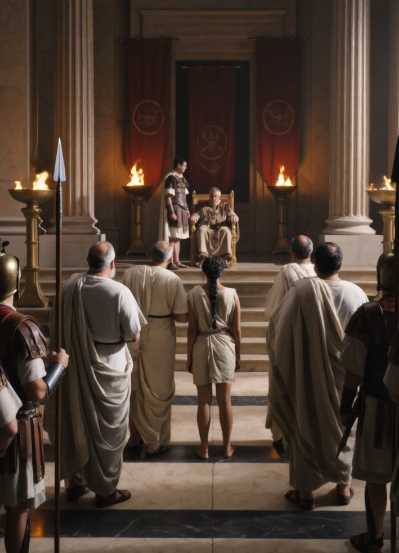
She looked only at the emperor.
Her voice shook, but she did not bow.
“Before you die, Emperor… you must tell them who I really am.”
The hall exploded with whispers.
Cassian stepped forward, his eyes burning.
“Guards,” he said, “remove her.”
Two soldiers moved toward the girl.
But the dying emperor raised one trembling hand.
The soldiers stopped.
No one breathed.
The emperor stared at the girl as though he had seen a ghost.
“Do not touch her,” he whispered.
Cassian turned to him in disbelief.
“Father, she is nothing. She is a street rat.”
The emperor’s eyes filled with tears.
“No,” he said. “She is the reason Rome is still standing.”
The girl reached into her torn cloak and pulled out a small golden box. It was old, scratched, and sealed with imperial wax. The moment the senators saw it, several of them gasped.
That box had belonged to Empress Aurelia, the emperor’s first wife.
She had died twenty years earlier after giving birth to a child who, according to the palace records, had not survived the night.
With shaking hands, the girl opened the box.
Inside was a ring.
A royal ring.
Gold, carved with the wolf of Rome and the private symbol of the imperial bloodline.
The emperor closed his eyes.
A priest stepped forward, pale with fear.
“That ring disappeared the night the emperor’s first child died.”
The girl turned toward Cassian.
“She did not die,” she said softly.
Cassian’s face turned white.
The hall went silent again.
The emperor forced himself to stand. The guards rushed to help him, but he pushed them away. For the first time in years, the old ruler stood on his own feet.
His voice was weak, but every person in the palace heard it.
“Twenty years ago, my first wife gave birth to a daughter. My daughter. My true firstborn.”
Cassian took one step back.
The emperor continued.
“I was told the child had died. I was told my wife died from grief. But the truth was hidden from me.”
His eyes moved to Cassian.
“My son feared that a firstborn child from the first empress would threaten his future claim. So he ordered the baby taken from the palace and left to die.”
A scream came from one of the noblewomen.
Cassian shouted, “Lies!”
But no one looked convinced.
The girl lifted her sleeve. On her wrist was a small birthmark shaped like a crescent moon.
The old priest dropped to his knees.
“The mark of Empress Aurelia’s bloodline,” he whispered.
Cassian reached for his sword.
The guards immediately surrounded him.
For the first time in his life, the prince looked afraid.
The emperor stepped down from the throne and walked slowly toward the girl. Every step seemed painful. Every breath sounded like his last.
When he reached her, he placed the royal ring into her hand.
Then he turned to the senators.
“Rome does not belong to the cruel,” he said. “It belongs to the one who survived them.”
Cassian shouted, cursed, and begged the generals to stand with him.
No one moved.
The girl looked at the emperor with tears in her eyes.
“I was raised in the streets,” she whispered. “I do not know how to rule.”
The emperor smiled sadly.
“That is why you may be the only one worthy of the throne.”
Then he placed his crown at her feet.
By sunrise, Rome had a new ruler.
Not the golden prince.
Not the cruel heir.
But the barefoot girl who had entered the palace as a slave — and walked out as the lost daughter of the emperor.
And years later, the people would say she became the greatest ruler Rome had ever known, because she never forgot what it felt like to be powerless.